Engineering Zero-Drop 3D Souvenir Fridge Magnets: Recessed N52 Neodymium Bonding, Coastal Salt-Fog Defense & Multi-Layer Riveting
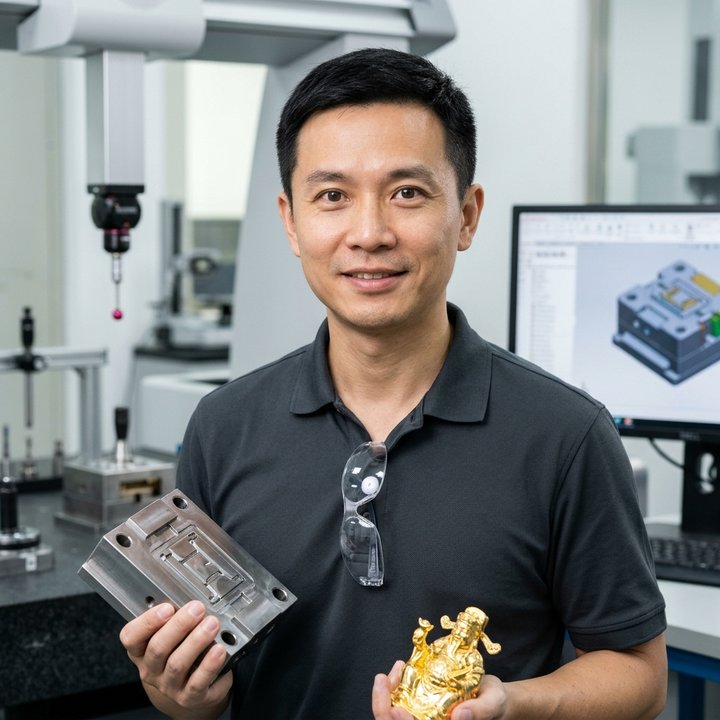
Verified Shop-Floor SOP • Quanzhou 35,000 m² Die-Casting & Plating Campus
Every July and August, right after peak trans-Pacific and Suez Canal summer container arrivals, tourism retail buyers from Key West, Honolulu, Lisbon, and national museum gift shops call my engineering desk at ArtisZinc Metalcrafts Co., Ltd. describing the exact same nightmare. Their newly unpacked 3D metal souvenir magnets look gorgeous through the retail blister card—until a store clerk hangs them on a vertical steel display tower and hears a sharp metallic clatter. The rare-earth magnet disc stays stuck fast to the steel rack while the heavy 85-gram antique bronze cathedral casting falls straight onto the ceramic floor, leaving behind a smooth, shiny puddle of yellowed glue inside the rear recess. Two months later, the remaining stock hanging near open boardwalk doors develops chalky white corrosion pustules erupting right through the antique copper valleys.
Neither failure is bad luck, and neither requires switching away from heavy die-cast zinc alloy. Both stem from workshop shortcuts that ignore adhesive glass-transition thermodynamics, differential thermal expansion, and coastal chloride electrochemistry. Over eighteen years building multi-layer architectural, museum, and resort souvenir magnets here at ArtisZinc, my team has engineered a zero-drop mechanical and chemical retention architecture specifically validated for 65°C ocean-freight containers and humid marine gift shops. Below is the exact shop-floor blueprint we use to guarantee zero detached magnets and 96-hour salt-spray endurance.
1. Why Magnets Pop Off in 62°C Sea Containers: The Hot-Melt & Brittle Cyanoacrylate Trap
To understand why souvenir magnets fail before a tourist ever buys them, follow a forty-foot high-cube container loaded at port in June. Stacked on the top tier of a container ship crossing the Red Sea or sitting in a Long Beach rail yard, internal container roof air temperatures routinely hit 58°C to 64°C during midday solar loading, then plunge to 18°C overnight—repeating that 45°C thermal swing thirty-five consecutive times amidst 85% relative humidity.
Cut-rate giftware workshops attach magnets using one of two cheap adhesives because they set in ten seconds on an assembly conveyor: EVA hot-melt glue sticks or un-toughened monomeric ethyl cyanoacrylate ("super glue"). Both are guaranteed time bombs on electroplated zinc alloy:
- EVA Hot-Melt Softening Creep: Commodity EVA glue sticks exhibit a softening point around 68°C–75°C, but lose over 75% of their cohesive shear modulus once ambient temperature crosses 52°C. Worse, molten EVA has high surface tension and zero chemical covalent bonding to bright nickel or electrophoretic lacquer—it merely sits atop microscopic plating oils. Inside a 62°C sea container, even carton vibration causes the adhesive film to creep and delaminate cleanly from the smooth Ni-Cu-Ni magnet face.
- Monomeric Cyanoacrylate Thermal-Shock Embrittlement: Standard one-part super glue cures into a rigid, glass-brittle thermoplastic chain with almost zero peel or impact resistance. Look at the Coefficient of Thermal Expansion (CTE) mismatch across the bond joint: die-cast Zamak-3 expands at 27.4 × 10⁻⁶ /K, whereas sintered NdFeB (neodymium-iron-boron) expands at only 5.0 × 10⁻⁶ /K parallel to magnetization (and slightly negative perpendicular to magnetization!). Across an ∅12 mm magnet pocket cycling between 18°C and 62°C, interfacial shear strain fractures rigid cyanoacrylate micro-bonds before the vessel even docks. The very first time a shopper snaps the magnet briskly onto a stainless refrigerator door, impact shock pops the brittle glue wafer loose.
2. ArtisZinc's Zero-Drop Bonding Architecture: Cast Pocket Geometry + Plasma + 18 MPa Toughened Epoxy
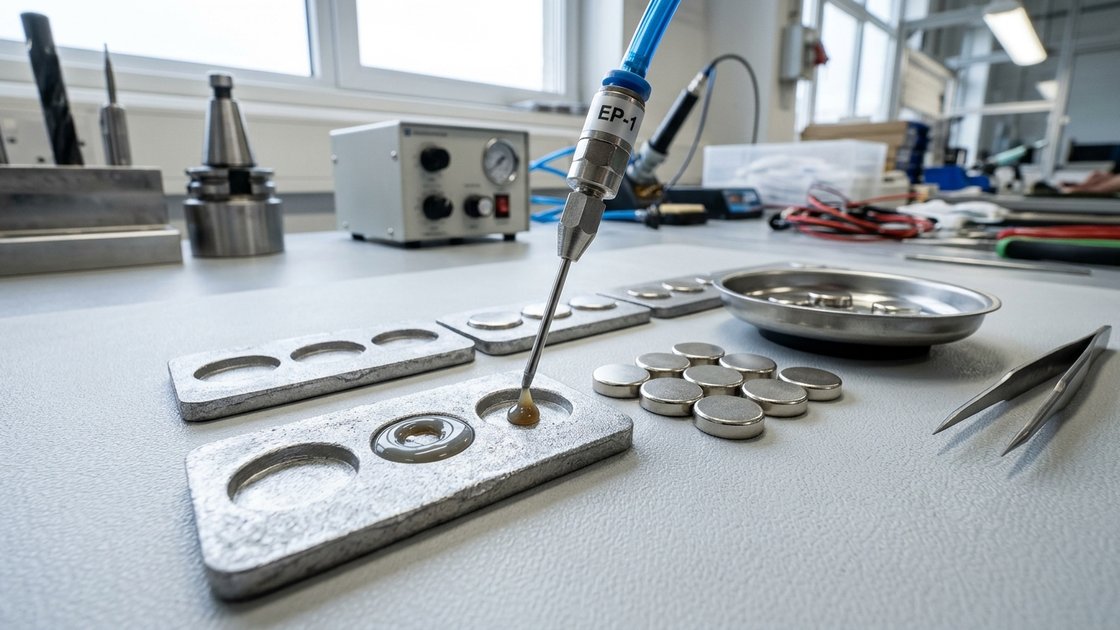
A permanent structural bond between sintered NdFeB and die-cast Zamak-3 requires treating the joint as an aerospace metal-to-metal hybrid interface rather than a craft glue-up. At ArtisZinc, we engineer four interlocking defenses into every custom 3D souvenir magnet:
- Cast 0.85 mm Recessed Pocket with Concentric Anchor Grooves & Adhesive Relief Channels: Never glue a magnet flat onto an un-recessed backplate! Flat surface-glued magnets suffer pure peel and side-shear forces whenever someone slides the magnet across a refrigerator door. Instead, we machine a dedicated cylindrical pocket directly into the H13 steel rear core pin, 0.80 mm to 1.00 mm deep, leaving only 0.6 mm to 0.8 mm of the 1.5 mm–2.0 mm thick magnet protruding proud of the casting backplane. Better yet, the steel core transfers three concentric 0.20 mm dovetail-style micro-rings onto the pocket floor so cured adhesive forms a positive mechanical key, while radial vent flutes allow trapped air to escape without pushing the magnet crooked.
- Masking or Laser Ablation of E-Coat Inside the Bond Pocket: Remember that our souvenir castings receive a slick, corrosion-proof electrophoretic clearcoat (E-coat) after electroplating. Gluing onto glossy E-coat means your magnet is only held by the adhesion of clear lacquer! Before dispensing adhesive, our rotary indexing stations pass the rear pocket beneath a 30-watt fiber-laser micro-etch head (or atmospheric plasma nozzle) that vaporizes surface organic release films and raises surface energy above 58 dynes/cm while creating a microscopic cross-hatch anchor tooth in bare metal.
- Rubber-Toughened Two-Part Structural Epoxy / Modified Methacrylate (Lap Shear > 18 MPa): We meter a 2:1 static-mixed, elastomer-toughened structural epoxy-acrylic hybrid engineered specifically for dissimilar CTE metals. Dispersed core-shell rubber nanoparticles inside the cross-linked epoxy matrix absorb refrigerator slam shock and accommodate the 5.5x CTE differential between Zamak-3 and NdFeB from -25°C to +110°C (glass transition temperature Tg ≥ 95°C), delivering > 18.5 MPa (2,680 psi) tensile lap shear strength per ASTM D1002.
- Controlled 0.12 mm Bondline Spacer Beads: Pressing a magnet too tightly squeezes out adhesive ("starved joint"). Our structural paste contains 0.10–0.12 mm calibrated glass micro-beads that guarantee uniform film thickness across every single cavity.
1. Required Normal Pull Force: Fpull ≥ (SFslide · mcasting · g) / μstatic
• Where casting mass mcasting (kg), g = 9.81 m/s2, static friction coefficient μstatic ≈ 0.18 (plated metal on painted/brushed steel fridge), and dynamic slam/paper-holding Safety Factor SFslide = 3.5
2. Example for a Heavy 90 g (0.090 kg) Multi-Layer 3D Landmark Magnet:
• Fpull ≥ (3.5 × 0.090 × 9.81) / 0.18 = 17.17 N (1.75 kgf minimum axial pull) → Achieved via twin recessed ∅10 mm × 2.0 mm N52 NdFeB discs (combined pull 28.4 N)
3. N52 Rare-Earth Discs vs. Non-Scratching Isotropic/Anisotropic Ferrite Rubber Backings
Not every retail venue wants exposed metallic neodymium discs touching an appliance door. Luxury kitchenware stores and cruise-ship gift shops frequently request scratch-free full-coverage magnetic backs, whereas museum shops selling heavy 110-gram 3D relief cathedrals demand maximum holding power through five sheets of A4 calendar paper. Here is how we match magnet metallurgy to your buyer's exact retail spec:
| Magnet System Option | Magnetic Energy Product (BH)max | Holding Capacity & Scratch Profile | Ideal Souvenir Magnet Application |
|---|---|---|---|
| Single or Twin Recessed N52 NdFeB (Ni-Cu-Ni + Epoxy Coat) | 48 – 52 MGOe (380 – 415 kJ/m3) | 1.4 – 3.6 kgf axial pull; ultra-compact; optional 0.15 mm clear PET anti-scratch pad | Heavy 65–130 g 3D architectural reliefs, kinetic spinners & magnet bottle-openers |
| N38–N42 NdFeB Flush-Potted inside Silicone Cup | 36 – 42 MGOe (285 – 335 kJ/m3) | 1.2 – 2.4 kgf axial pull; high-friction μ = 0.55 silicone boot prevents sliding & scratching | Premium appliance-safe museum collectibles & cruise-line stateroom souvenirs |
| 1.5–2.0 mm Anisotropic Die-Cut Strontium Ferrite Sheet | 1.4 – 1.7 MGOe (11 – 13.5 kJ/m3) | 0.45 – 0.85 kgf across full silhouette; soft flexible polymer matrix; 3M 9448A + structural primer | Flat/semi-3D ≤ 48 g silhouette skyline magnets requiring full flush rear coverage |
| Ceramic C8 Hard Ferrite Disc (∅18 × 4 mm) | 3.2 – 3.8 MGOe (25 – 30 kJ/m3) | 0.55 – 0.90 kgf; zero rare-earth corrosion risk even in raw salt water; thick 4 mm profile | Deep-recess rustic cast-look outdoor patio & tiki-bar souvenir plaques |
Notice one crucial detail whenever we specify N52 neodymium for coastal tourist destinations (Florida Keys, Mediterranean islands, Caribbean cruise ports, Sydney Harbour): sintered NdFeB is iron-rich and corrodes rapidly into brown magnetic dust if moisture breaches a cheap single-layer zinc coating. Therefore, ArtisZinc exclusively procures triple-layer Ni-Cu-Ni plated N52 discs (or black epoxy top-coated Ni-Cu-Ni-Epoxy marine grade) verified in 72-hour PCT autoclave humidity chambers before assembly.
4. Defeating Coastal Gift-Shop Salt Fog: Duplex Barrier Plating & Cathodic E-Coat
Why do cheap antique brass and antique pewter souvenir magnets erupt in fuzzy white blisters ("white rust") within ninety days of hanging in an open-air seaside shop? Because zinc sits at -0.76 V on the standard electrochemical potential series, whereas copper (+0.34 V) and silver/gold sit far more noble. Whenever airborne sea-salt aerosols (NaCl droplets) settle into microscopic pinholes left in thin 2 μm flash plating, every pinhole becomes a galvanic corrosion pit eating straight down into the Zamak-3 substrate, pushing voluminous zinc hydroxide carbonate crystals out onto the artwork.
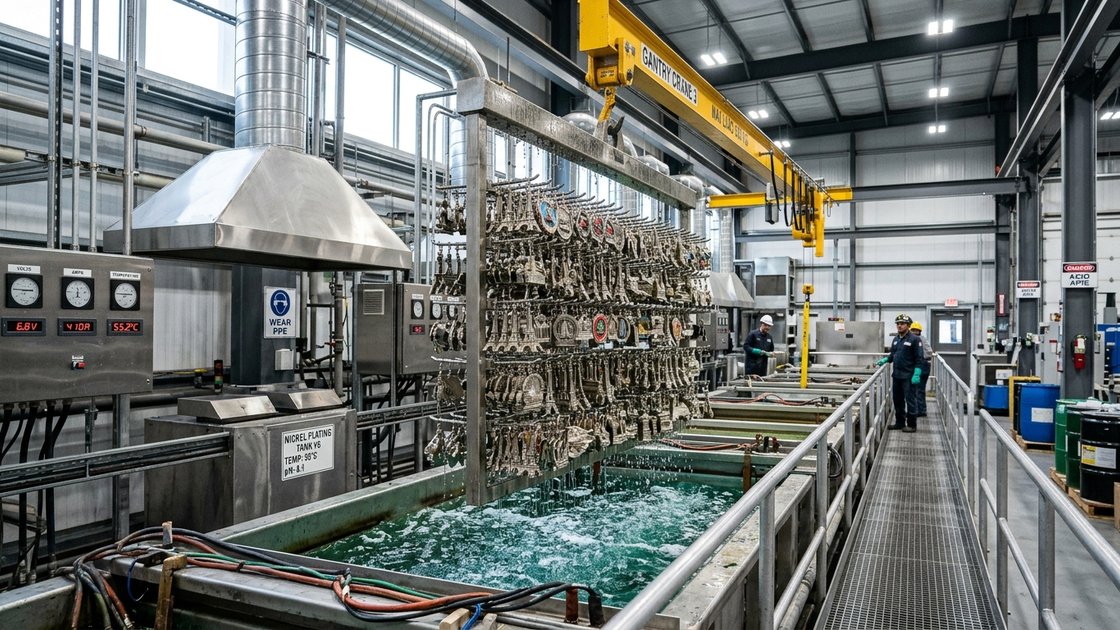
To pass 72 to 96 hours of ASTM B117 (ISO 9227) 5% neutral salt-spray fog at 35°C with zero white corrosion and zero blistering, ArtisZinc seals every 3D souvenir magnet beneath a four-tier metallurgical armor:
- Vibratory Ceramic Burnishing Before Rack Entry: We tumble raw castings in high-density spherical porcelain media with mildly acidic organic brighteners to cold-work and close microscopic surface micropores without rounding crisp 0.15 mm cathedral spires or cobblestone textures.
- 8–10 μm Cyanide-Free Alkaline + Acid Copper Cushion: Deposits a dense, pore-free ductile sealing blanket across deep 3D recessed valleys where low-current-density Faraday-cage effects starve single-step baths.
- Barrier Nickel or Nickel-Free White Bronze (Cu-Sn) Layer: Provides electrochemical STEP potential protection (or EU REACH EN 1811 compliant Cu-Sn barrier for European museum accounts).
- Hand-Relieved Chemical Antique Patina + 10–12 μm Cathodic Electrophoretic Clearcoat: After artisans hand-highlight the raised 3D landmarks (leaving rich dark antique contrast inside recessed architectural shadows), racks immerse into an aqueous cathodic polyurethane E-coat bath. Driven by DC voltage, charged polymer micelles migrate into the deepest crevices and cross-link at 155°C for 30 minutes into an invisible, UV-stabilized ceramic-clear film that blocks salt-fog chloride ions completely.
5. Multi-Layer Riveting, Sliding Tramcars & Kinetic 3D Souvenir Mechanisms
Walk into any top-performing museum store in London, San Francisco, or Tokyo today and the best-selling $12–$18 retail magnets are rarely static flat plaques—they are multi-layer 3D kinetic dioramas. Think of a Golden Gate Bridge magnet where a miniature cable car slides back and forth across a hidden slot track, a Parisian Eiffel Tower magnet framed behind protruding foreground bistros, or a rotating astronomical clock dial.
Engineering kinetic and multi-tier riveted magnets so they glide smoothly without jamming or scratching enamel requires tight mechanical stack-up tolerances:
- Integral Cast Hollow Rivet Posts (Cold-Orbital Flared): Rather than buying loose tubular rivets, we cast Ø2.4 mm solid-root / hollow-tip integral Zamak-3 bosses directly onto the rear of the foreground 3D layer (using ductile Zamak-3, elongation 10%). After separate plating and enameling of Layer 1 (background skyline) and Layer 2 (3D foreground bridge), precision orbital riveting heads cold-flare the post inside a countersunk rear pocket—creating a rock-solid 1.8 mm parallax shadow gap between layers with zero visible hardware on the front or back!
- PTFE/Nylon Washer-Guided Sliding Tracks: For sliding tramcar, ferryboat, or ski-gondola magnets, metal rubbing directly against plated metal scrapes off clearcoat within fifty slides. We sandwich a 0.30 mm ultra-slick POM/PTFE Delrin glide washer onto a stepped brass shoulder pin riding inside a CNC-deburred 2.60 mm ± 0.04 mm guide slot, giving shoppers an addictive, velvety-smooth mechanical slide that survives 10,000+ store-display actuations.
6. Shop-Floor SOP: 7-Gate Reliability Protocol for Custom 3D Souvenir Magnets
| Verification Gate | Engineering Specification | Test Method & Equipment | Sampling Plan & Action |
|---|---|---|---|
| Gate 1: Virgin Zamak-3 & Pocket Cast | ASTM B240 Zamak-3; pocket depth 0.85 ± 0.04 mm with 3 anchor micro-grooves | Spark OES + Depth Micrometer | Every furnace shift + 5 pcs per 500 shots |
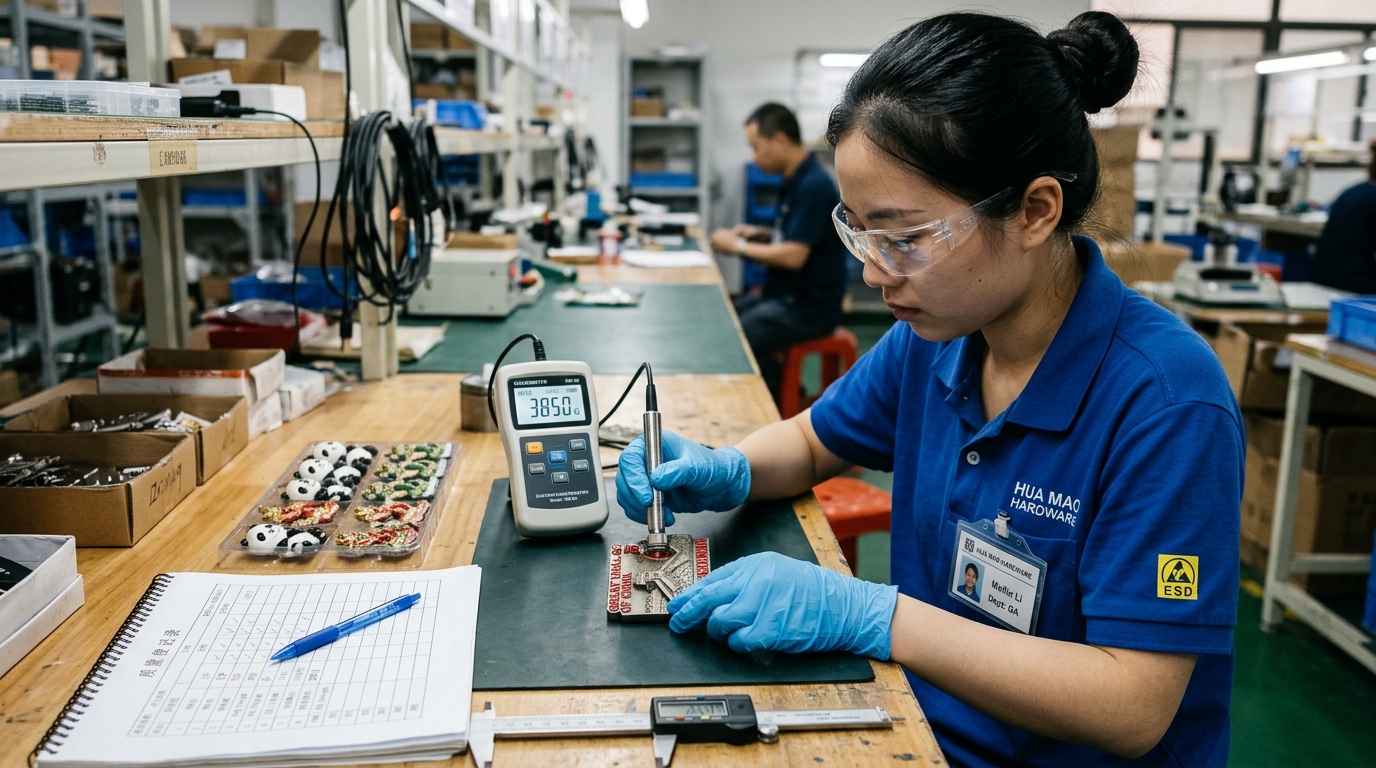
| Gate 2: Incoming N52 Magnet Audit | Flux density ≥ 4,200 Gauss (surface); Ni-Cu-Ni coating 15–20 μm pinhole-free | Digital Gaussmeter + 72h 85°C/85% RH Damp-Heat | 20 pcs per incoming magnet lot; reject under-magnetized batches |
| Gate 3: Coastal Plating & E-Coat | Cu + Barrier + Patina + 10 μm E-coat; 72h–96h neutral salt fog zero white rust | ASTM B117 Salt-Spray Chamber + Cross-Hatch 5B | Witness coupons per plating shift + 100% visual relief check |
| Gate 4: Pocket Laser Clean & Bond | Laser/plasma pocket prep; 2K toughened epoxy-acrylic metered ±2% by weight | Dyne Test Ink (≥58 dynes/cm) + CNC Dispenser Log | Hourly mix-ratio gravimetric check; 24h full cross-link cure before pack |
| Gate 5: 65°C Sea-Freight Thermal Shock | 5 cycles of (-15°C 2h ↔ +65°C / 90% RH 4h) followed by ≥180 N magnet pry test | Programmable Environmental Chamber + Push-Pull Rig | 10 pcs per production batch; zero adhesive cohesive/interfacial release |
| Gate 6: 1.2m Ceramic Tile Drop Test | 3 drops from 1.2 m height onto porcelain floor tile (flat, edge, face) | Drop Tower Jig | 8 pcs per batch; zero magnet detachment, rivet loosening, or casting crack |
| Gate 7: Retail Carding & Air-Cargo Shield | Pb < 20 ppm, Cd < 10 ppm; IATA Packing Instruction 953 magnetic stray-field check (<0.00525 Gauss at 4.6 m) | XRF Analyzer + Compass/Fluxgate Meter on Master Carton | Every air-shipped master carton lined with keeper steel strips when required |
Look closely at Gate 7—that final line saves tourism importers thousands of dollars in stalled DHL/FedEx air shipments! When you pack 250 high-grade N52 neodymium magnets into one export carton without magnetic shielding, their combined dipole field easily deflects aircraft navigation sensors and triggers IATA Dangerous Goods PI 953 rejection at airport X-ray screening. For urgent air-freighted resort restocks, ArtisZinc arranges opposing alternating polarity trays flanked by 0.5 mm cold-rolled ferromagnetic keeper sheets inside double-wall cartons so external stray flux at 2.1 meters stays well below aviation limits.
7. Retail Pegboard Card Engineering & Preventing N52 Thermal Demagnetization
Two additional real-world details separate smoothly selling museum souvenir programs from logistical headaches: Curie/operating temperature magnet grade selection and retail display card hang-tab reinforcement. Standard room-temperature N52 sintered NdFeB magnets carry a maximum continuous operating temperature (Tmax) of 80°C—because intrinsic coercivity (Hcj) drops as temperature climbs. If an un-educated workshop tries to cure enamel or heat-shrink thick PVC blister sleeves at 115°C after inserting standard N52 discs, irreversible flux loss permanently strips 35% to 50% of the magnet's pull strength! At ArtisZinc, 100% of high-temperature baking (135°C enamel and 155°C E-coat) completes before magnet bonding, and whenever a desert national park or automotive dashboard souvenir demands elevated heat resistance, we upgrade to N48M (100°C rated) or N45H (120°C heavy-dysprosium coercivity) discs verified on our Helmholtz fluxmeter coil.
Meanwhile, inside airport and gift-shop aisles, tourists don't always hang magnets directly on steel towers—half of retail stores hang barcoded 400 gsm coated display cards on standard Euro-slot wire pegs. Hang an 85-gram solid zinc alloy 3D magnet onto thin 250 gsm cardstock with weak double-sided foam tape, and humidity peels the magnet off the card within two weeks! We package heavy 3D magnets onto 450 gsm matte-laminated virgin kraft or artboard using either concealed rear ferromagnetic steel strike washers taped behind the card (so the N52 magnet clamps itself tightly through the card!) or custom thermoformed 0.40 mm recycled APET blister cradles with reinforced Euro-slot hang holes sustaining 45 N peg tear loads.
Engineering Floor Q&A: Sourcing Custom 3D Souvenir Fridge Magnets
Q1: Can you combine high-resolution photo scenery (like sunset ocean gradients) with 3D sculpted metal frames?
Marcus Lin: Absolutely—that hybrid construction is one of our highest-sell-through museum formats. We die-cast a richly detailed 3D antique-plated Zamak-3 architectural border (layer 2) and orbital-rivet it over a recessed 1,440 dpi UV-cured aluminum or offset-printed background plate sealed beneath an optical non-yellowing polyurethane dome, giving tourists vibrant photographic sky gradients framed by authentic cold-cast metal relief.
Q2: How do we prevent heavy metal souvenir magnets from scratching stainless-steel luxury refrigerators?
Marcus Lin: We solve scratch concerns two ways: first, our recessed pocket sets the polished radiused face of the Ni-Cu-Ni magnet 0.70 mm proud of the surrounding zinc casting so metal borders never touch the door; second, for ultra-sensitive retail specs, we die-cut a 0.12 mm transparent high-friction matte polyurethane or black velvet-flocked protective film directly across the backplane and magnet face—boosting vertical anti-slip friction by 240% while eliminating metal-on-metal contact completely.
Q3: What is the weight sweet spot for a retail $9.99–$14.99 museum gift-shop magnet?
Marcus Lin: Perceived heirloom value peaks between 55 grams and 95 grams at a footprint of 65 mm × 55 mm with 3.2 mm to 4.5 mm multi-level 3D relief depth. Below 35 grams, shoppers perceive thin stamped tin; above 115 grams, pegboard retail header cards require reinforced hang-hole grommets and twin ∅12 mm N52 magnets.
Q4: Can you embed mixed materials—such as laser-etched FSC walnut wood, stained glass, or Abalone shell—inside 3D zinc magnet frames?
Marcus Lin: Yes. National park and lodge buyers love mixed-media 3D zinc frames cradling CNC-routed 2.0 mm walnut wood or mother-of-pearl inlays. Because natural wood swells and shrinks with seasonal humidity while Zamak-3 stays rigid, we maintain a 0.20 mm perimeter expansion relief hidden beneath an overhanging cast bezel lip and bond the inlay with flexible MS-polymer elastomer so wood never warps or cracks. We also formulate transparent tinted cathedral resins and strontium-aluminate night-glow enamels inside pierced 3D skylight windows, turning lighthouse, Northern Lights, and stained-glass cathedral magnets into luminous collectibles that command premium $14.99–$19.99 museum retail price points.
Q5: Can we launch a 5-landmark city collection without paying 5x massive MOQs?
Marcus Lin: Yes. Custom 3D tooling starts at 500 pieces per sculpt (or 200 pieces using modular stocked shield/stamp outer frames with custom insert centers), 48-hour 3D prototypes, and 12–16 day bulk production—with 100% mold fee refund once each design hits 5,000 cumulative pieces. Send your landmark photos or concept sketches to [email protected] and we will return a 3D depth-map rendering and N52 pull calculation within 24 hours. Our packaging engineers also pre-apply retail EAN/UPC barcodes, multilingual museum provenance stories, and tamper-resistant security hang tabs onto every carded unit so shipments move straight from arrival port onto gift-shop display racks without secondary warehouse repacking labor.
Need a Free 12-Hour Mold-Flow & Plating Review on Your Design?
Send your 2D vector art or 3D STEP/STL sculpture directly to Marcus Lin's tooling desk for wall-thickness, draft-angle, and cost-tier optimization.
More Peer-Reviewed Metallurgical & Tooling Whitepapers
- → Zamak-3 vs. Zamak-5 in Heavy Bottle Openers: Jaw Shear Mechanics, Porosity Control & 45 N·m Torque Testing (Bottle Opener Metallurgy • 14 min read)
- → Hard Enamel Cloisonné vs. Recessed Soft Enamel Keychains: Lapping Tolerances, 0.15mm Metal Dam DFM & Split-Ring Fatigue (Keychain Craft & Enameling • 14 min read)
- → Sculpting 28mm–75mm Die-Cast Zinc Alloy Figurines: Four-Slide Core Pulls, Invisible Parting Lines & Centrifugal vs. Steel Tooling (Metal Figurines & Miniatures • 14 min read)
- → Manufacturing Heirloom Enameled Zinc Alloy Trinket Boxes: ±0.03mm Hinge Coaxiality, Magnetic Closure Damping & Hand-Set Crystal QC (Hinged Jewelry & Trinket Boxes • 14 min read)
- → Passing ASTM B117 96-Hour Salt Spray & California Prop 65 on Custom Zinc Alloy Gifts: Duplex Plating, Nickel-Free Finishes & XRF Gatekeeping (Surface Finishing & Compliance • 14 min read)