Sculpting 28mm–75mm Die-Cast Zinc Alloy Figurines: Four-Slide Core Pulls, Invisible Parting Lines & Centrifugal vs. Steel Tooling

Verified Shop-Floor SOP • Quanzhou 35,000 m² Die-Casting & Plating Campus
Every tabletop RPG publisher, luxury board-game Kickstarter creator, and museum gift buyer eventually hits the exact same wall with 3D-printed photopolymer resin and PVC plastic miniatures. Out of the velvet foam tray, a 35 mm paladin or 65 mm dragon bust looks sharp—until a player accidentally sweeps an elbow across the gaming table. The miniature tumbles 75 centimeters onto hardwood, and the raised broadsword, eagle wingtip, or ankle ankles snap clean off like dry pasta. Worse, pick up a hollow 9-gram PVC board-game token next to a 68-gram solid die-cast zinc alloy figurine finished in hand-rubbed antique pewter: the cold thermal conductivity and dense gravitational authority of real metal instantly justify a $79–$149 collector edition box price.
Yet the moment a digital sculptor exports a ZBrush `.STL` or `.OBJ` file created for 3D printing and sends it to an ordinary two-plate medal factory, the quote comes back tagged "Impossible to Mold—Severe Undercuts Everywhere." Unlike flat coins or keychains that open along a single North-South parting plane, a true 360-degree figurine features billowing capes, crossed halberds, hollowed shield backs, and undercut jawlines facing six directions at once. Over eighteen years building both multi-slide H13 steel die-casting molds and high-durometer vulcanized silicone centrifugal spin-cast molds here at ArtisZinc Metalcrafts Co., Ltd., my tooling engineers have turned "un-moldable" ZBrush sculpts into repeatable, flash-free metal collectibles. Here is how we engineer 28 mm to 75 mm figurines from digital mesh to antique wash.
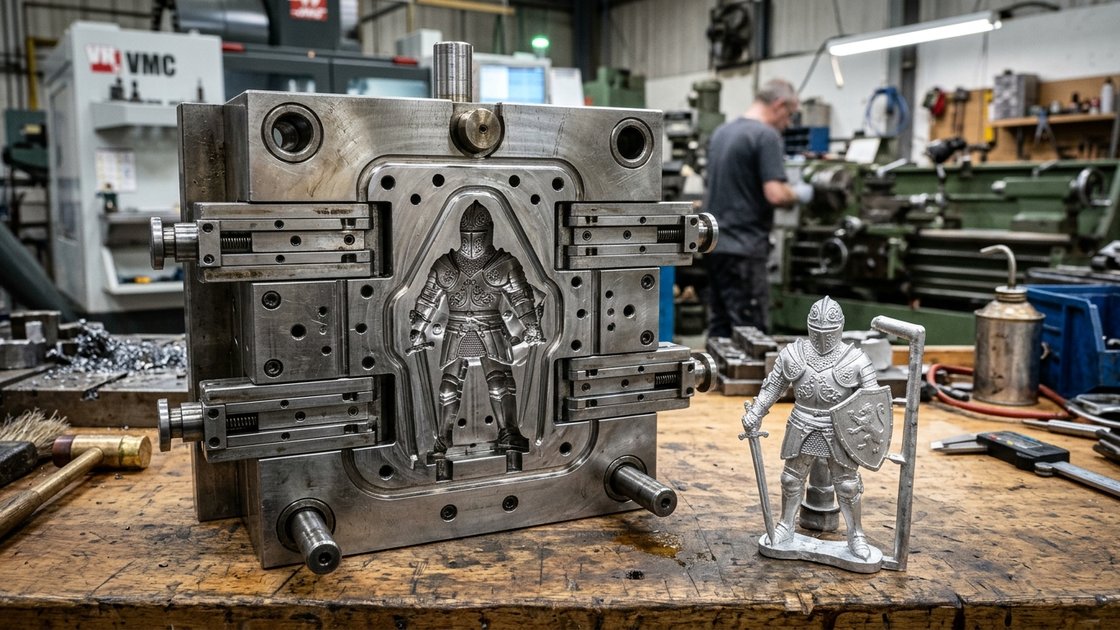
1. Solving 360° Undercuts: Two-Plate vs. Four-Slide H13 Steel Tooling vs. Multi-Piece Keyed Assembly
In rigid steel high-pressure hot-chamber die-casting, solidified Zamak-3 has high shear strength (214 MPa) and virtually zero elastic give. If even a 0.25 mm overhang behind a miniature knight's belt pouch hooks beneath steel along the mold opening vector, the part locks inside the cavity, bends ejector pins, or rips facial features off during ejection.
When my DFM team receives a ZBrush mesh (typically 1.5 million to 4 million triangles), we run a spherical draft-angle color-map analysis in Materialise Magics and Siemens NX, then solve undercuts using a three-tier engineering hierarchy—never blunting your artist's silhouette into a "melted snowman":
- Tier 1 — Directional Draft Sculpting & Micro-Bridge Filling (≤ 0.4 mm Undercuts): Tiny unintentional voids beneath folded fingers, beard braids, or boot buckles that nobody can see from normal viewing angles are subtly tapered at 2.5°–3.5° along the local slide pull vector, adding structural strength to fragile 1.1 mm ankles and sword hilts at the same time.
- Tier 2 — Four-Slide Angular Cam Pins & Hydraulic Core Pulls: Rather than opening solely in +Z and -Z halves, we build a four-direction (or five-direction) H13 steel slider block assembly hardened to 48 HRC. As the die-casting platen retracts, hardened 18°–22° mechanical angle pins (and sequenced hydraulic cylinders for long core strokes) simultaneously retract North, South, East, and West side-cores outward before ejector pins push the figurine forward off the base plug! This allows deep hollowed cloaks, pierced scabbards, and full facial ear/helm detail in a single monolithic metal shot.
- Tier 3 — Concealed Dovetail Mortise-and-Tenon Multi-Part Split: When a 75 mm winged griffin or dual-wielding boss miniature spans wider than practical slide vectors, we split the wings or outstretched weapon arm right along an anatomical armor pauldron seam or feather ridge. We cast precision trapezoidal keyed tenons (+0.00/-0.03 mm interference/slip fit) that lock into matching torso sockets with structural anaerobic metal adhesive prior to copper strike plating—so the electroplated metal skin bridges the joint seamlessly!
2. Centrifugal Spin-Casting (Silicone Rubber) vs. High-Pressure H13 Steel Die-Casting: The Crossover Formula
One of the smartest cost decisions a tabletop studio or museum merchandiser can make is choosing the right casting technology for your exact run size. Why pay $2,400 for a complex 4-slide H13 steel mold if you are only producing 300 numbered VIP Kickstarter rewards? Conversely, why pay high spin-cast piece prices if your board game needs 15,000 sets of eight character movers?
At ArtisZinc, we operate both technologies under one roof using 100% lead-free virgin zinc alloys—never toxic tin-lead "white metal" pewter! In centrifugal spin-casting, we CNC-machine or SLA-print brass/master patterns, vulcanize them between two 230 mm–300 mm discs of high-tear organic/silicone rubber at 170°C under 18 tons of vulcanizer pressure, hand-cut radial gates and air knife-vents with surgical scalpels, and spin the clamped mold at 450 to 750 RPM while pouring molten high-fluidity zinc alloy (Zamak-2 or spin-grade ZA-8/Zamak-3) down the central sprue. Because vulcanized silicone flexes elastically by 12%–18% when opening, moderate 3D undercuts pull right out of a two-piece rubber mold without expensive steel slides!
1. Total Batch Cost Comparison: Cspin_mold + N · (Pspin_unit + Crubber_renewal / Lrubber) = Csteel_mold + N · Psteel_unit
2. Real Floor Parameters for a 38 mm Detailed RPG Hero Figurine (Weight 26 g):
• Spin-Cast: Master + Vulcanized Mold Cspin_mold = $260; Mold Life Lrubber ≈ 350 shots (4 cavities = 1,400 pcs per rubber disc, renewal $95); Piece Cost Pspin_unit = $1.92
• 4-Slide H13 Steel Die: Csteel_mold = $1,480 (Mold life 150,000+ shots); Piece Cost Psteel_unit = $1.04
3. Solving for Breakeven Quantity Ncrossover:
• Ncrossover = ($1,480 - $260) / ($1.92 + $0.068 - $1.04) = $1,220 / $0.948 ≈ 1,287 units! (Typically 1,200 – 1,800 units depending on slide complexity; plus steel mold fee is 100% refunded at 5,000 units!)
| Engineering Criterion | Centrifugal Vulcanized Silicone Spin-Casting | 4-Slide H13 Steel Hot-Chamber Die-Casting |
|---|---|---|
| Upfront Tooling Investment | $220 – $380 (Brass master + vulcanized disc) | $1,150 – $2,600 (CNC/EDM hardened H13 multi-slide) |
| Undercut Capability | Moderate 360° undercuts flex free naturally | Solved via 4-way slides or keyed multi-part split |
| Dimensional Repeatability | ±0.12 mm – ±0.20 mm (Slight rubber swell) | ±0.03 mm – ±0.05 mm (Precision interlocking bases) |
| Thin-Section Sword/Spear Strength | Good (Gravity/centrifugal G-force 35–60 G) | Superior (32 MPa pressure + dense 0.4 mm chill skin) |
| Parting-Line Witness Seam | 0.08 – 0.15 mm soft flash requiring hand knife/media | ≤ 0.04 mm precision wire-EDM matched steel land |
| Optimal Order Volume | 200 – 1,300 pcs per character sculpt | 1,300 – 250,000+ pcs (100% mold refund at 5,000 pcs) |
3. Hiding Parting Lines Along Anatomical Ridges & Preventing Bent Swords
Nothing ruins a collector figurine faster than a jagged mould parting seam slicing straight across a character's nose, smooth breastplate, or bald cranium. Amateur toolmakers split a 3D model down a lazy flat mathematical XY plane in CAD. At ArtisZinc, our master mold designers build 3D non-planar stepped parting surfaces machined via 5-axis CNC and mirror-spark sinker EDM (surface finish Ra 0.25 μm, slide shut-off clearance ≤ 0.015 mm).
We intentionally route parting witness lines along high-contrast natural anatomical transitions: the sharp crest of a cape hem, the outer spine of a greave armor plate, hairline braids, and belt seams. Where four steel slides meet along a shoulder pauldron, wire-EDM shutoff lands mate within 15 microns so post-cast witness traces vanish during micro-media tumbling without an operator ever touching a grinding wheel to sculpted detail!
What about long, slender 1.3 mm rapiers, wizard staffs, or horse legs that bend in transit? Two metallurgical upgrades solve thin-appendage bending:
- Upgrading to Zamak-2 (ASTM B240 Alloy 2, 2.6%–2.9% Copper): When a miniature carries ultra-slender weapons, Zamak-2 boosts Brinell hardness to 100 HB and ultimate tensile strength to 359 MPa (52,000 psi)—the highest strength and creep resistance in the conventional Zamak family, while offering exceptional thin-wall fluidity!
- Concealed Ø0.8 mm SUS304 Stainless Wire Insert-Molding: For long 65 mm ceremonial spears or flagstaffs, operators load a pre-cut knurled Ø0.8 mm spring-temper stainless steel core wire right into magnetic locators inside the mold cavity before shooting zinc around it—creating an unbendable composite metal spear!
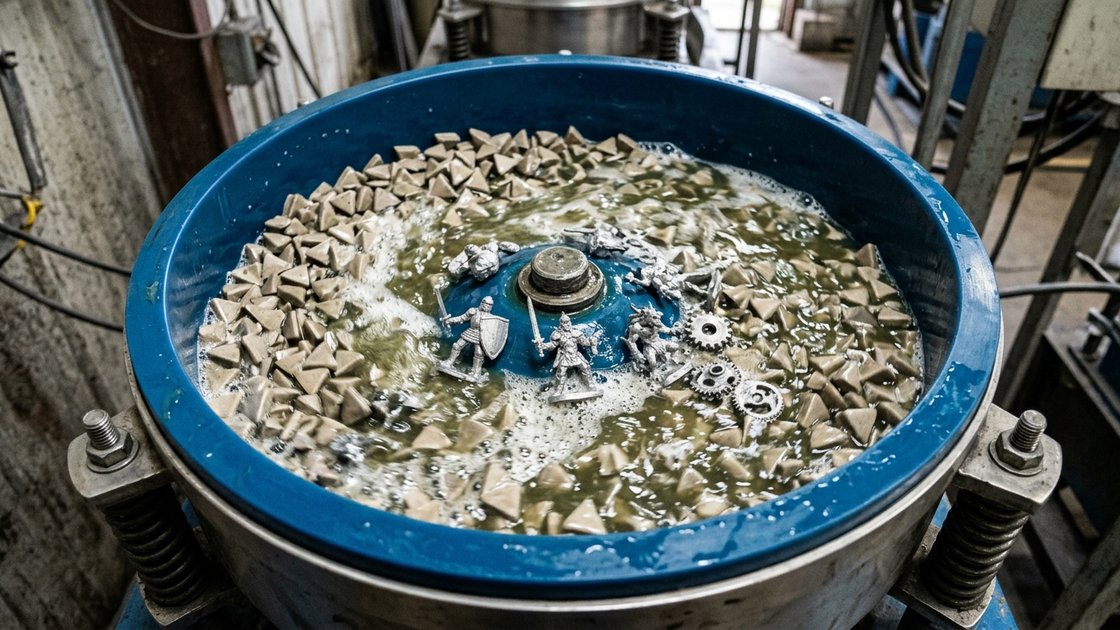
4. Non-Blunting Vibratory Media Selection: Preserving 0.12mm Chainmail & Facial Features
Drop fifty freshly cast 28 mm elves into a standard hardware drum loaded with coarse 15 mm silicon-carbide triangular stones for two hours, and they will come out smooth—with their noses, chainmail rings, and rune inscriptions completely erased! Preserving 0.10 mm to 0.15 mm ZBrush micro-textures requires tuning abrasive mass geometry so media removes micro-flash at parting seams without bridging or peening crisp ridges:
- Stage 1 — Cryogenic or Soft Brass-Pin Micro-Deflashing (18 Minutes): Castings enter a gentle toroidal vibratory bowl filled with non-cutting 1.8 mm × 5 mm smooth porcelain diagonal pins suspended in saponified botanical compound. The tiny 1.8 mm pin tips reach inside arm-to-torso crevices to knock off 0.03 mm brittle flash feathers with zero abrasive cutting rate on convex noses or knuckles.
- Stage 2 — Treated Maize / Walnut Shell Dry Luster Polish: For figurines receiving translucent antique washes, dry tumbling with 1.0 mm treated walnut shell granules imparts a warm, satin metallic sheen across raised armor plates so subsequent dark antiquing wipe-off glides cleanly without catching in rough pores.
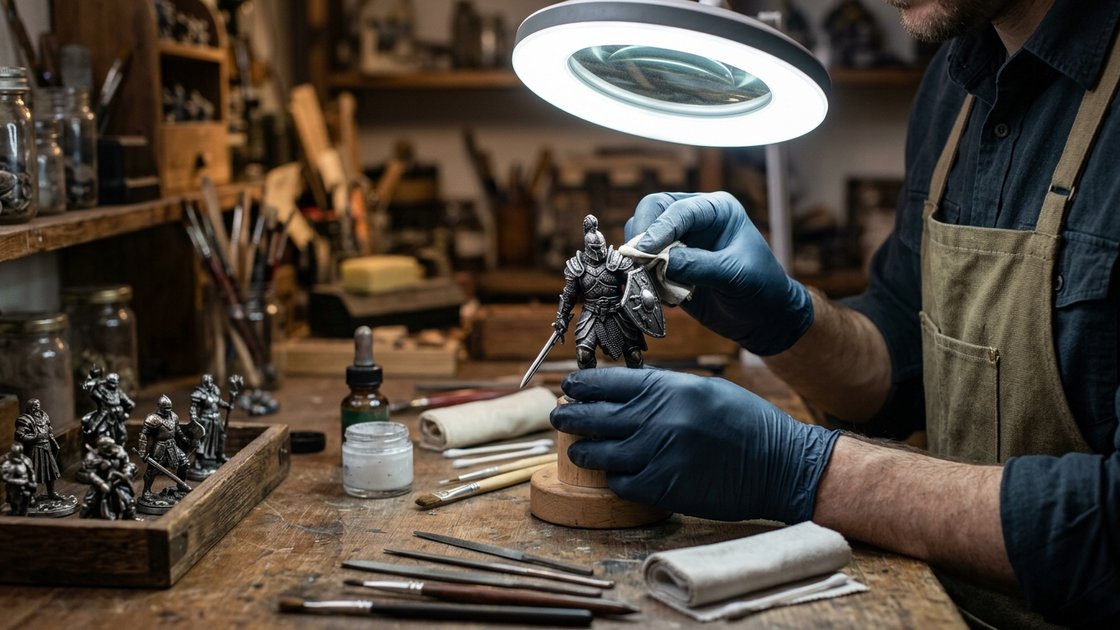
5. Hand-Rubbed Antique Pewter Wash & Matte Primer-Ready Surface Engineering
Tabletop gamers and museum collectors fall into two camps: collectors who display raw metallic finishes (Antique Pewter, Antique Bronze, Satin 24K Gold Boss Editions), and miniature painters who prime and paint models with acrylics (Vallejo, Citadel). ArtisZinc engineers dedicated surface treatments for both:
- Collector Antique Pewter / Silver Wash ("Liquid Shadow"): After depositing cyanide-free copper and lead-free satin white-bronze/silver underplates, racks immerse in a controlled selenium-tellurium oxidizing bath that turns the entire miniature charcoal black. Skilled finishers then lightly buff each figurine across soft chamois wheels—wiping dark oxide strictly off raised cheekbones, sword edges, and cloak folds while leaving deep black contrast pooled inside chainmail links and eye sockets—followed by a low-gloss matte cathodic E-coat (gloss level 15–22 GU at 60°) so the model never looks plasticky or shiny under studio photography!
- Painter's Micro-Etched Bare Metal Edition: For hobbyist paint-ready SKU boxes, we omit slick organic lacquers entirely, delivering ultrasonic-degreased, micro-passivated bare virgin Zamak-3/Zamak-2 miniatures with an ideal Ra 0.8 μm micro-tooth so water-based acrylic primers grip tenaciously without beading.
6. Shop-Floor SOP: 7-Stage Quality Control for 28mm–75mm Metal Figurines
| Process Gate | Target Specification & Tolerance | Inspection Apparatus | Sampling & Disposition |
|---|---|---|---|
| Gate 1: ZBrush Mesh & Slide DFM | Min wall/sword thickness ≥ 1.15 mm; zero locked undercuts; hidden 3D parting seam | Siemens NX Draft Analysis + SLA 8K Master Print | Client interactive 3D PDF sign-off in 24h–48h prior to cutting steel/rubber |
| Gate 2: Lead-Free Melt Purity | ASTM B240 Virgin Zamak-3 / Zamak-2; Total Pb < 20 ppm, Cd < 10 ppm (Zero Lead Pewter!) | Spark OES Spectrometer (CPSIA / EN71-3 / Prop 65) | Every melt lot verified; strict segregation from outside alloys |
| Gate 3: Base Flatness & Slot Fit | Integral base flatness ≤ 0.08 mm wobble on granite plate; 25 mm/32 mm hex/round lip ±0.05 mm | Granite Surface Plate + Feeler Gauge | 100% stand-stability table check after gate trim |
| Gate 4: Micro-Detail & Seam Audit | Parting witness ≤ 0.04 mm; zero cold-shut flow lines on face or shield crest | 20x Binocular Inspection Microscope | AQL 1.0 audit post-vibratory ceramic pin tumble |
| Gate 5: Antique Contrast & Salt Fog | Matched against signed Golden Master light/dark relief card; 72h–96h ASTM B117 salt spray | D65 Light Booth + Salt-Spray Chamber + Glossmeter | Side-by-side master comparison on every rack tray |
| Gate 6: 1.5m Tabletop Drop & Bend | Survive 3 drops from 1.5 m onto oak hardwood without weapon fracture or base joint split | 1.5 m Drop Chute + Sword Deflection Gauge | 5 pcs per 1,000 units tested before foam tray kitting |
| Gate 7: Die-Cut EVA Foam Kitting | Custom waterjet/die-cut velvet-topped EVA foam cavity + XRF compliance CoA | ISTA 2A Vibration & Drop Carton Simulation | Zero transit scuffing on protruding spears or wings |
7. Multi-Cavity "Family Mold" Runner Balancing for Board-Game Character Packs
Board-game publishers and chess-set designers frequently ask a smart tooling question: "Marcus, our game box includes six distinct 32 mm hero miniatures—a barbarian, mage, rogue, archer, cleric, and dwarf. Can you cut all six characters into one single H13 steel 'family mold' so we only pay one tooling fee instead of six?"
Yes—provided the mold engineer balances hydrodynamic runner fill time using finite-element mold-flow simulation (AnyCasting / MAGMASOFT) before cutting steel! Think about what happens inside an unbalanced family die when Cavity #1 is a bulky 42-gram armoured ogre while Cavity #2 right beside it is a slender 14-gram elf archer. If both cavities share identical runner cross-sections and gate widths, molten Zamak-3 takes the path of least resistance—filling the tiny 14-gram elf cavity in 9 milliseconds while the bulky 42-gram ogre is still only 35% full! That premature stall subjects the small figurine to excessive hydraulic flash blow-out along its parting line while starving the bulky figurine of intensification pressure, leaving shrinkage voids in its chest.
At ArtisZinc, whenever we group two to six figurines into an economical family tool (saving publishers 45% to 60% in upfront H13 steel tooling!), we size each branch runner and fan-gate cross-sectional area Agate,i strictly proportional to individual cavity volume Vi divided by target fill time tfill (typically 16 to 22 milliseconds across all cavities simultaneously). Every character freezes at the exact same millisecond, yielding crisp 0.12 mm facial features across both massive bosses and petite spellcasters on every machine cycle—and automatically producing matched 1:1:1 character sets ready for direct foam-tray kitting without miscounted inventory!
8. Scale Discipline Across 28mm Heroic, 32mm Skirmish, 54mm Collector & 75mm Display Busts
Different collector markets judge miniature proportions by strict historical scale conventions, and shrinkage math matters when figurines must lock into third-party plastic terrain tiles or tournament movement trays:
- 28 mm "Heroic" & 32 mm Skirmish Wargaming Scales (Foot-to-Eye Height): Base pucks must hold strict 25.0 mm, 32.0 mm, or 40.0 mm outer diameters (±0.08 mm) after accounting for 0.67% Zamak-3 solidification shrinkage (or 1.1%–1.3% double-shrinkage when making vulcanized silicone spin-cast molds from 3D-printed masters!). We thicken heroic proportions slightly—hands, jawlines, and weapon shafts—by 8%–12% so visual readability pops from three feet above a gaming table.
- 54 mm (1:32 Historical/Military) & 75 mm Display Figurines: At 54 mm to 75 mm scale, single solid zinc castings weigh between 110 grams and 290 grams! Solid cross-sections thicker than 9 mm inside a horse torso or bust chest risk internal centerline shrinkage porosity and excessive cycle cooling times. Therefore, we insert water-cooled internal coring pins ("hollow-belly coring") up through the underside of the plinth base—maintaining a uniform 3.0 mm to 4.0 mm structural metal shell that cuts unit metal cost by 30%, eliminates surface sink marks on smooth capes, and preserves an authoritative 165-gram heirloom heft in the hand.
Engineering Floor Q&A: Custom Metal Figurines & Tabletop Miniatures
Q1: Our ZBrush artist sculpted ultra-thin 0.5 mm ribbons and sword blades for resin 3D printing—do we have to remodel everything from scratch?
Marcus Lin: No! Send us your raw ZBrush `.ZTL` or `.STL` file as-is. Our in-house digital sculptors selectively inflate sub-millimeter fragile blades and ankles to 1.15–1.30 mm with tapered sharp bevel edges—so to the naked eye a sword edge still looks razor-thin, while gaining 6x the bending section modulus needed for high-speed molten zinc fill and tabletop survival. You review and approve a rotatable 3D comparison model before we cut any tooling.
Q2: Why are some imported "pewter" miniatures banned under US CPSIA or EU toy/collectible rules while ArtisZinc's pass easily?
Marcus Lin: Old-school hobby shops used low-temperature "white metal" spin-cast alloys spiked with 15% to 45% toxic lead to lower melting temperature and cheapen tin costs—exceeding CPSIA's 90 ppm/100 ppm lead limit by 3,000x! ArtisZinc operates a 100% lead-free foundry using certified virgin ASTM B240 Zamak-3/Zamak-2 (<20 ppm Pb, <10 ppm Cd), verified by XRF on every outgoing shipment so your boxed game clears US Customs, Amazon safety audits, and European EN71-3 testing effortlessly.
Q3: Can we start with 300 spin-cast miniatures for our Kickstarter launch and upgrade to H13 steel tooling later if retail demand explodes?
Marcus Lin: Yes, we run that exact two-stage bridge launch every month. We engineer your 3D master sculpt so it works cleanly in low-cost centrifugal silicone tooling for your initial 200–800 backer wave, then seamlessly cut multi-cavity 4-slide H13 steel molds when retail distribution hits 1,500+ units—crediting 100% of your steel mold fee back once cumulative volume reaches 5,000 units per sculpt!
Q4: Can you embed hidden neodymium magnets under miniature bases for magnetic carrying cases or modular weapon-swapping arms?
Marcus Lin: Absolutely! We routinely cast recessed ∅5.0 mm × 1.5 mm pockets into the underside of 25 mm/32 mm figurine bases (and ∅2.0 mm × 1.0 mm micro-pockets inside shoulder pauldrons for interchangeable magnetic sword/bow loadouts), bonding polarity-matched N52 discs flush with structural epoxy so miniatures snap securely onto steel transport trays. To prevent frustrating polarity mix-ups—where Player A's sword arm repels Player B's torso—our assembly line utilizes foolproof magnetic poka-yoke master jigs that only accept North-outward orientation discs during automated dispensing, guaranteeing 100% cross-compatibility across every expansion pack your studio releases over multiple years. We can also pad-print or enamel color-coded faction rings around the base bevel for instant tabletop player identification.
Q5: Can you assemble complete collector sets—like 32-piece weighted metal chess sets or numbered museum plinth busts?
Marcus Lin: Yes. Beyond casting and antiquing the figurines, our assembly floor laser-engraves individual serial numbers (`0001/2500`), bonds weighted felt base pads, mounts brass nameplates onto walnut or marble plinths, and packs complete multi-character sets into custom velvet-flocked EVA collector boxes within our standard 12 to 16 day production window. Email your `.STL` files or concept turnarounds to [email protected] for a 24-hour undercut & crossover cost analysis. We also archive every client's vulcanized master brass patterns and hardened steel slide inserts inside climate-controlled tooling vaults for ten years, enabling rapid seasonal restocks or metallic gold anniversary editions whenever publisher demand surges.
Need a Free 12-Hour Mold-Flow & Plating Review on Your Design?
Send your 2D vector art or 3D STEP/STL sculpture directly to Marcus Lin's tooling desk for wall-thickness, draft-angle, and cost-tier optimization.
More Peer-Reviewed Metallurgical & Tooling Whitepapers
- → Zamak-3 vs. Zamak-5 in Heavy Bottle Openers: Jaw Shear Mechanics, Porosity Control & 45 N·m Torque Testing (Bottle Opener Metallurgy • 14 min read)
- → Hard Enamel Cloisonné vs. Recessed Soft Enamel Keychains: Lapping Tolerances, 0.15mm Metal Dam DFM & Split-Ring Fatigue (Keychain Craft & Enameling • 14 min read)
- → Engineering Zero-Drop 3D Souvenir Fridge Magnets: Recessed N52 Neodymium Bonding, Coastal Salt-Fog Defense & Multi-Layer Riveting (Souvenir Fridge Magnets • 14 min read)
- → Manufacturing Heirloom Enameled Zinc Alloy Trinket Boxes: ±0.03mm Hinge Coaxiality, Magnetic Closure Damping & Hand-Set Crystal QC (Hinged Jewelry & Trinket Boxes • 14 min read)
- → Passing ASTM B117 96-Hour Salt Spray & California Prop 65 on Custom Zinc Alloy Gifts: Duplex Plating, Nickel-Free Finishes & XRF Gatekeeping (Surface Finishing & Compliance • 14 min read)