Passing ASTM B117 96-Hour Salt Spray & California Prop 65 on Custom Zinc Alloy Gifts: Duplex Plating, Nickel-Free Finishes & XRF Gatekeeping

Verified Shop-Floor SOP • Quanzhou 35,000 m² Die-Casting & Plating Campus
Nothing derails a Q4 retail launch faster than receiving a failed third-party SGS, Bureau Veritas, or Intertek lab report forty-eight hours before your sea container is scheduled to clear Los Angeles or Rotterdam customs. Over my eighteen years managing metallurgical quality and surface finishing at ArtisZinc Metalcrafts Co., Ltd., corporate procurement directors have forwarded me dozens of painful compliance post-mortems caused by previous low-bid vendors: 40,000 promotional keychains quarantined under a California Proposition 65 60-Day Notice because cheap brass jump rings and recycled zinc ingots tested at 480 ppm lead; European museum souvenir pins recalled under EU REACH Annex XVII Entry 27 because exposed nickel underplating leached 3.8 μg/cm2/week in artificial sweat; or luxury gold medallions arriving covered in tiny volcano-like plating blisters after crossing the Pacific.
Every single one of those disasters is 100% preventable when surface finishing and heavy-metal compliance are engineered as deterministic electrochemistry rather than treated as an afterthought outsourced to an uncertified back-alley plating shed. Unlike brass or stainless steel, die-cast ASTM B240 Zamak-3 and Zamak-5 zinc-aluminum alloys are amphoteric—meaning bare zinc dissolves aggressively in both strong acids (pH < 3.5) and strong alkalis (pH > 11.5)! Electroplating zinc alloy successfully while hitting 96-hour ASTM B117 salt-spray endurance, EU EN 1811 nickel-free standards, and <20 ppm Prop 65/CPSIA heavy-metal limits requires controlling every micron from ultrasonic degreasing down to outgoing XRF verification. Here is the exact compliance and plating manual we enforce at ArtisZinc.
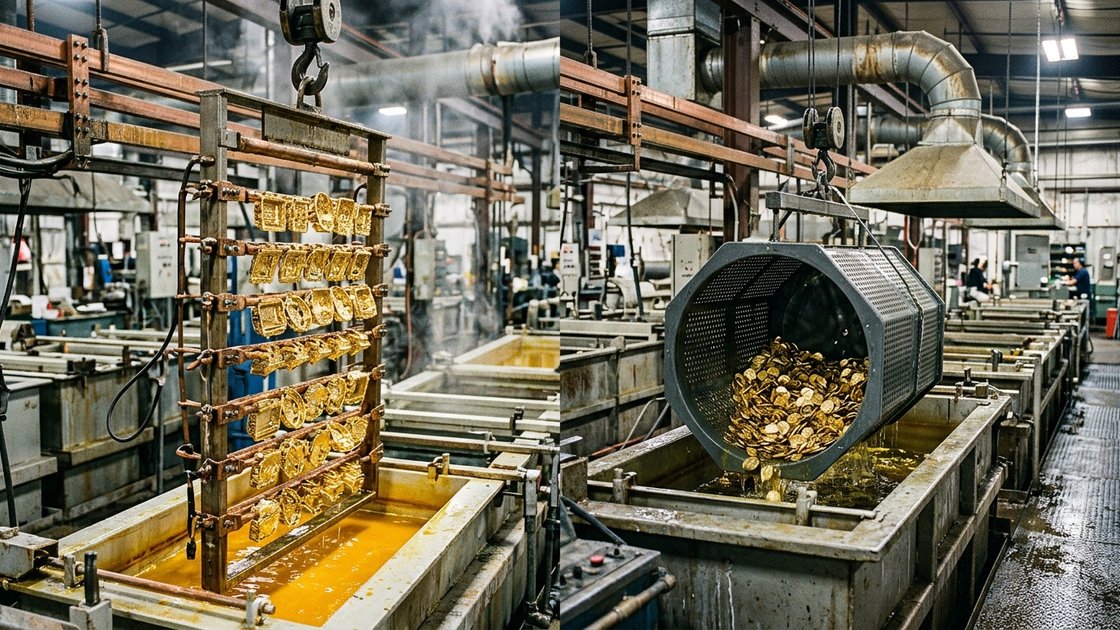
1. Why Plated Zinc Alloy Blisters in Ovens or Humid Storage—And How We Eliminate It
Ask any veteran electroplater what separates a world-class zinc die-casting finisher from an amateur shop, and they will point straight to subsurface blister prevention. Have you ever inspected a newly plated zinc coin or bottle opener that looked flawless at room temperature, only to watch 0.5 mm dome-shaped blisters pop up across its face after baking soft enamel at 135°C or sitting in humid summer storage for three weeks?
Here is the exact chemical chain reaction behind plating blisters on Zamak-3/Zamak-5—and the four process gates ArtisZinc locks down to eliminate them:
- Root Cause #1 — Over-Pickling Acid Etch & Trapped Hydrogen Gas: Before plating, raw polished zinc castings still carry microscopic traces of stearic-acid buffing wax and thin native zinc oxide films. If an operator leaves castings inside harsh hydrochloric or sulfuric acid dip tanks for 45 seconds instead of a gentle organic-fluoride dip, acid eats straight through the dense outer casting skin into subsurface interdendritic micropores, evolving gaseous hydrogen (Zn + 2H+ → Zn2+ + H2↑) and trapping acidic liquid inside porous pockets. Once sealed beneath copper and nickel, heating that casting inside a 135°C enamel oven or 155°C E-coat oven causes trapped hydrogen and steam pressure to exceed plating bond strength—blowing up surface blisters!
- Root Cause #2 — Direct Acid-Copper Immersion Dissolution: Dipping bare zinc directly into an acidic copper sulfate bath causes instantaneous electroless displacement ("immersion copper"): zinc dissolves while depositing a spongy, non-adherent red copper powder that peels off like wet wallpaper under cross-hatch tape testing.
- ArtisZinc's Four-Step Zero-Blister Pre-Treatment Protocol:
- Multi-Frequency Ultrasonic Saponification (55°C, pH 9.2 inhibited silicate-borate cleaner): Strips Tripoli and white-rouge buffing compounds cleanly out of 3D crevices without attacking amphoteric zinc.
- Mild Cathodic Electro-Cleaning (< 15 Seconds) + Buffered Organic Fluoride Activation (pH 4.2, 8–10 Seconds): Micro-activates surface oxides cleanly without opening subsurface pores or charging hydrogen.
- Non-Cyanide Alkaline Pyrophosphate / Tartrate Copper Strike (6–8 μm): Deposits a dense, fine-grained, zero-immersion molecular bridge bonded metallurgically to virgin Zamak-3 (passing 20-minute 160°C thermal bake blister screening before advancing!).
- Bright Leveling Acid Copper Cushion (10–14 μm): Fills microscopic polishing lines to mirror smoothness (Ra ≤ 0.08 μm) and seals every surface pore hermetically before barrier plating.
2. Rack Electroplating vs. Barrel Plating: Choosing the Right Fixture Architecture
Buyers comparing unit quotes sometimes wonder why one supplier prices plating $0.16 lower per piece—until bulk production arrives covered in tiny "fish-scale" dings across smooth mirror fields. That price gap reflects rotary barrel plating versus individual spring-clip rack plating:
- Individual Titanium/Plastisol Rack Plating (ArtisZinc Standard for Medallions, Openers, Figurines, Boxes & Hard Enamel): Operators mount each casting individually onto spring-loaded copper-core / titanium-tip racks. Parts never collide against one another, electrical current density (ASD — Amperes per Square Decimeter) is tuned precisely with auxiliary anodes/thieves so deep 3D recesses receive uniform thickness without burning sharp corners, and mirror gold or rhodium surfaces emerge flawless.
- Controlled Slow-RPM Barrel Plating (Reserved Strictly for Small Hardware & Rustic Textured Tokens ≤ 18 g): Only used for split rings, jump rings, dog-tag chains, or compact pebble-textured tokens without flat mirror planes, rotating at slow 4–6 RPM inside polypropylene perforated barrels so tumbling parts never dent sharp edges.
3. Passing ASTM B117 72h–96h Neutral Salt Spray: Duplex Nickel STEP Potential & Cathodic E-Coat
Suppose your client is a global beverage brand, coastal resort chain, yacht club, or outdoor automotive marque demanding a certified 72-hour or 96-hour ASTM B117 (ISO 9227) neutral 5% NaCl salt-spray report with Rating ≥ 9 per ASTM B537 (zero base-metal white zinc corrosion, zero blistering). A single thin layer of bright nickel plus flash gold will fail ASTM B117 in less than 16 hours! Why? Because sulfur-brightened bright nickel is electrochemically active; a single microscopic pore channels chloride ions straight down a vertical pinhole shaft into the copper and zinc below.
At ArtisZinc, our 96-hour coastal defense architecture diverts corrosion laterally and blocks chloride ingress completely using Duplex Nickel + Cathodic Electrophoretic Lacquer (E-Coat):
1. Layer A (Lower Barrier): Sulfur-Free Columnar Semi-Bright Nickel (< 0.005% S), Thickness dsemi = 8 – 10 μm
2. Layer B (Upper Leveling): High-Sulfur Laminar Bright Nickel (0.04% – 0.08% S), Thickness dbright = 5 – 7 μm
3. Simultaneous Thickness & Electrochemical Potential (STEP): ΔE = Esemi-bright - Ebright = +110 mV to +135 mV (Semi-bright layer is 110–135 mV more noble, forcing any micro-corrosion in bright nickel to spread harmlessly sideways rather than penetrating downward to the Zamak substrate!)
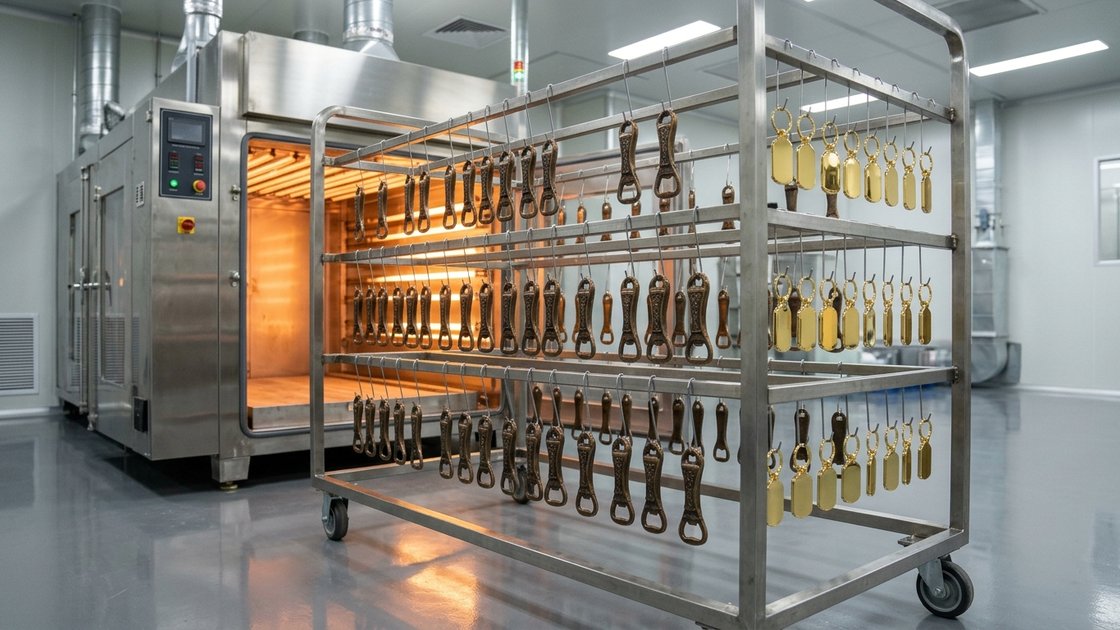
For antique brass, antique copper, antique pewter, and 24K gold decorative finishes, we lock the finished surface beneath a 10–12 μm cathodic polyurethane electrophoretic clearcoat (E-coat) rather than cheap dip-spun nitrocellulose lacquer. Unlike spray or dip lacquer that pools thickly in valleys while pulling thin to 1 μm over sharp badge edges due to surface tension, electrophoretic deposition uses DC electrical attraction to wrap every sharp corner and recessed letter uniformly, cross-linking at 155°C to achieve 3H–4H pencil hardness (ASTM D3363), 5B cross-hatch adhesion (ASTM D3359), 500+ MEK double-rub solvent resistance, and 96-hour ASTM B117 salt-spray immunity!
4. EU REACH Annex XVII Entry 27 (EN 1811 Nickel-Free Release) via Cu-Sn White Bronze
If your custom keychains, bag charms, zipper pulls, belt buckles, or wearable lapel pins ship into the European Union or UK, pay close attention to EU REACH Regulation (EC) No 1907/2006 Annex XVII Entry 27 tested under EN 1811:2023 (paired with EN 12472 simulated two-year wear-and-corrosion tumbling prior to artificial sweat immersion!). Any metal item intended for direct and prolonged skin contact must exhibit a nickel release rate strictly < 0.5 μg/cm2/week (and < 0.2 μg/cm2/week for pierced post assemblies).
Here is the trap that catches unseasoned importers: if a factory plates 0.08 μm flash gold over a conventional 10 μm nickel underplate and applies clear E-coat, EN 12472's abrasive ceramic-paste tumbling drum intentionally wears away that thin clearcoat and flash gold on corners before the 7-day EN 1811 artificial sweat soak—exposing raw nickel underneath and failing the lab test catastrophically!
Whenever an order specifies EU REACH EN 1811 compliance (or hypoallergenic retail positioning in North America), ArtisZinc routes the entire work order through our segregated 100% Nickel-Free Plating Line, substituting nickel completely with Ternary White Bronze (55% Cu – 40% Sn – 5% Zn speculum alloy) or Palladium-Iron barrier layers:
- Zero Nickel Ions Anywhere in the Stack: Alkaline Copper Strike (8 μm) → Acid Copper Cushion (10 μm) → Mirror/Satin White Bronze Barrier (6–8 μm, Vickers hardness 480–520 HV, warm platinum-silver color) → Decorative Gold / Rhodium / Antique Patina → Cathodic E-Coat. Even if EN 12472 tumbling grinds completely through the top gold layer, exposed White Bronze contains 0.00% nickel—scoring Non-Detect (< 0.05 μg/cm2/week) on every EN 1811 certificate!
5. California Prop 65, US CPSIA & EN71-3 Heavy-Metal Gatekeeping (<20 ppm Pb, <10 ppm Cd)
Across the United States and Europe, chemical safety enforcement on promotional gifts, souvenirs, drinkware openers, and collectible merchandise spans four overlapping frameworks that our compliance lab tests against daily:
| Regulatory Standard | Regulated Heavy Metals & Organics | Statutory / Settlement Limit | ArtisZinc Internal Release Ceiling |
|---|---|---|---|
| California Proposition 65 (Giftware, Keychains & Jewelry Settlements) | Total Lead (Pb), Cadmium (Cd), Phthalates (DEHP, DBP, BBP, DINP) | Pb ≤ 90 – 100 ppm (substrates & coatings); Cd ≤ 75 ppm; Phthalates ≤ 1,000 ppm | Total Pb < 20 ppm; Total Cd < 10 ppm; Phthalates Non-Detect (< 50 ppm) |
| US CPSIA (16 CFR 1303 & Sec. 101) / ASTM F963 | Total Lead in Substrates & Surface Coatings; Soluble 8 Heavy Metals | Pb ≤ 100 ppm (metal substrate) / ≤ 90 ppm (paint/enamel); Cd migratable limits | Total Pb < 20 ppm across base zinc, brass hardware, enamels & crystals |
| EU EN71-3 (Category III Scraped-Off Toy & Collectible Materials) | 19 Migratable Elements (Al, Sb, As, Ba, B, Cd, Cr III/VI, Co, Cu, Pb, Hg, Mn, Ni, Se, Sr, Sn, Org-Sn, Zn) | Migratable Pb ≤ 23 mg/kg; Cd ≤ 17 mg/kg; Cr(VI) ≤ 0.053 mg/kg (Hex-Chrome Free!) | 100% Trivalent Cr(III) passivation only; zero hexavalent chromate dips |
| EU REACH Annex XVII (Entries 23, 27, 63) & RoHS 3 | Total Cadmium, Total Lead, Nickel Release (EN 1811), SVHC 240+ List | Pb < 500 ppm; Cd < 100 ppm; Ni release < 0.5 μg/cm2/week | Pb < 20 ppm; Cd < 10 ppm; Ni-Free White Bronze option < 0.05 μg/cm2/week |
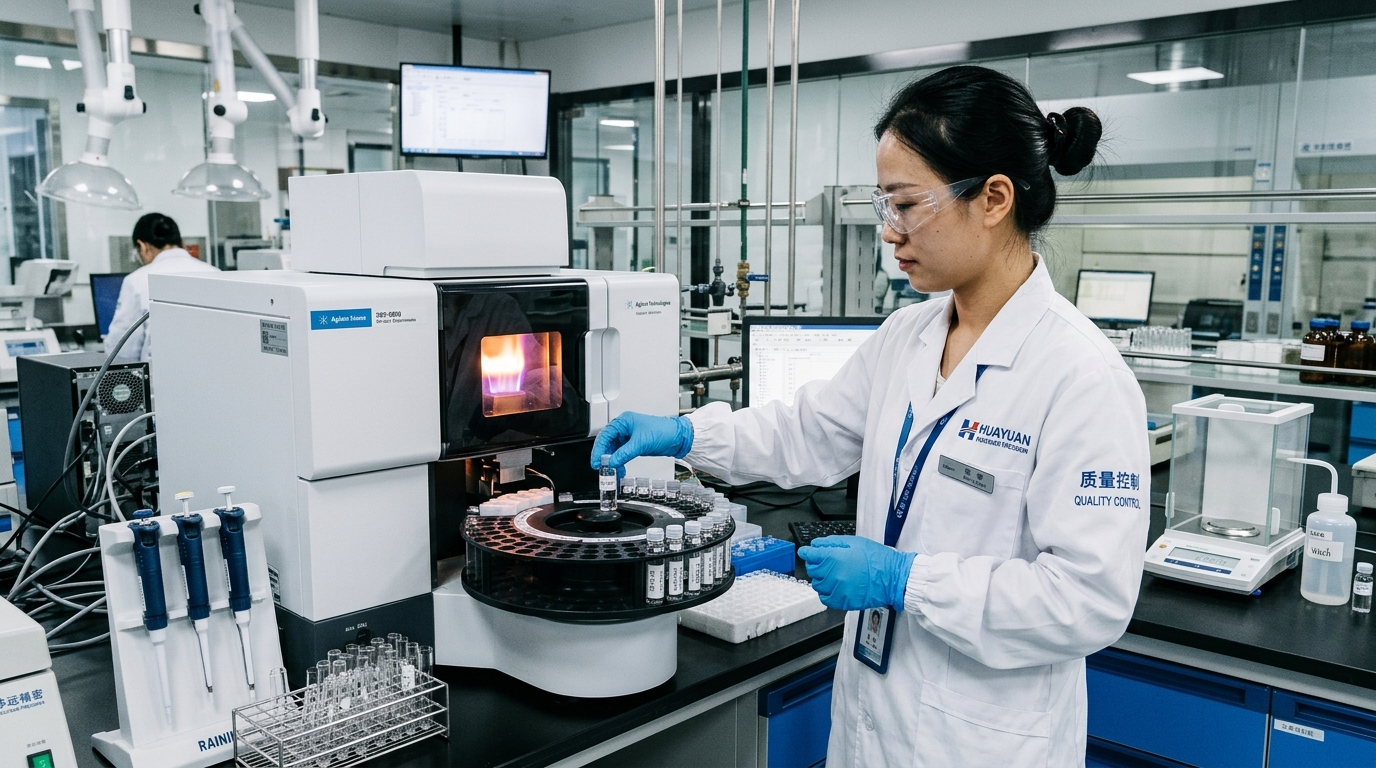
Why do many factories still fail Prop 65 even when their zinc medallion itself is clean? Accessory hardware contamination! A vendor casts the main medallion in clean Zamak-3, then buys cheap "free-machining leaded brass" (C36000, containing 2.5%–3.7% lead = 30,000 ppm Pb!) swivel clasps, eyelets, or mini-hinges from an unvetted hardware market! At ArtisZinc, our incoming QC quarantine cage scans every single component SKU separately—split rings, lobster clasps, chain links, crystals, magnets, velvet, PVC-free polybags, and enamel pastes—with our benchtop energy-dispersive X-Ray Fluorescence (ED-XRF) spectrometer before those components ever enter our assembly warehouse.
6. Shop-Floor SOP: 7-Gate Surface Finishing & Regulatory Compliance Protocol
| Control Gate | Process / Compliance Specification | Analytical Instrument / Standard | Cadence & Non-Conformance Lock |
|---|---|---|---|
| Gate 1: Raw Material & Hardware XRF | Ingots, clasps, chains, crystals & pigments: Pb < 20 ppm, Cd < 10 ppm, Hg/Cr6+ = ND | Olympus / Hitachi Benchtop ED-XRF + Spark OES | 100% incoming lot scan before barcode warehouse admission |
| Gate 2: Bath Chemistry & Hull Cell | pH, free chelating titration, brightener mL/kAh; Hull-cell panel test across 0.2–8 ASD | Auto-Titrator + Hull Cell Rectifier + Atomic Absorption | Every morning at 07:30 prior to energizing production racks |
| Gate 3: Blister Thermal Bake Screen | Alkaline + Acid Cu strike coupons baked at 160°C × 25 min; zero micro-blisters at 20x | Forced-Air Lab Oven + 20x Stereo Microscope | 5 witness pieces per tank startup shift before full-line release |
| Gate 4: Multi-Layer Thickness & STEP | Cu ≥ 15 μm, Barrier Ni/Cu-Sn ≥ 8 μm, Gold/Patina + 10 μm E-coat; STEP 110–135 mV | Fischerscope X-Ray Coating Thickness + Coulometric STEP | 5 pcs per 3 racks logged digitally by lot number |
| Gate 5: Adhesion, Hardness & Rub | ASTM D3359 Cross-Hatch = 5B (0% flake); Pencil ≥ 3H; 200 artificial-sweat cotton rubs | 1 mm Carbide Cross-Hatch Cutter + 3M 610 Tape + Crockmeter | 10 pcs per finish batch post-155°C E-coat curing tunnel |
| Gate 6: ASTM B117 Salt Fog & Sweat | 72h–96h 5% NaCl @ 35°C pH 6.5–7.2 Rating ≥ 9; ISO 3160-2 / EN 1811 artificial sweat check | Programmable Salt-Spray Cabinet + Synthetic Perspiration Bath | Continuous batch witness panels archived 12 months with photo logs |
| Gate 7: Outgoing CoA & 3rd-Party Lab | Serialized XRF Compliance Report + optional SGS / Intertek / TÜV pre-shipment test submission | ED-XRF + Accredited ISO/IEC 17025 External Lab | Every invoice accompanied by batch-matched XRF & Salt-Spray Certificate |
7. Selective Dual-Tone Electroplating (24K Gold + Rhodium Silver) Without Masking Halo Bleed
Corporate anniversary medallions, championship collector coins, and VIP bottle openers increasingly specify dual-tone selective electroplating—such as a raised 3D lion crest gleaming in mirror 24K gold set against a recessed sandblasted satin silver or antique pewter background. On low-cost production floors, workers brush liquid stop-off lacquer by hand under magnifying lamps, plate the second metal, and strip the lacquer in solvent. If the design lacks a crisp physical step wall, capillary creep beneath the stop-off resist leaves fuzzy, rainbow-colored gold/silver halo fringes along the boundary!
At ArtisZinc, we design dual-tone plating readiness right into the H13 steel mold geometry during DFM: every boundary separating Finish A from Finish B incorporates a dedicated 0.35 mm vertical step cliff or 0.25 mm V-groove trench. For batch runs above 1,000 units, we CNC-mill precision silicone elastomer conformable masking jigs (or dispense UV-curable peelable resist via 3-axis robotic needle) that seal cleanly into that V-groove—delivering razor-sharp two-tone gold-and-silver transitions before encapsulating the entire dual-plated piece inside a single continuous 10 μm cathodic E-coat shield.
8. How Procurement Teams Should Audit XRF Screening vs. Wet-Acid ICP-OES Lab Reports
One final compliance tip that has saved dozens of our US and European brand buyers from fraudulent supplier paperwork: never accept a three-year-old generic "raw zinc ingot SGS report" as proof that your finished custom gift passes Prop 65 or CPSIA!
Why? Because a clean ingot certificate tells you nothing about whether the factory contaminated the melt in a dirty furnace pot, soldered an attachment post with tin-lead solder, used leaded brass jump rings, or mixed cadmium-stabilized red pigment into soft enamel! Furthermore, understand the analytical boundary between ED-XRF screening (ASTM F2853 / IEC 62321) and Wet-Acid Microwave Digestion ICP-OES (CPSC-CH-E1001-08.3 / CPSC-CH-E1003-09.1):
- ED-XRF Spectrometry is a fast, non-destructive X-ray surface/near-surface screening tool (penetrating ~20–80 μm in metals and ~200 μm in polymers). When a multi-layer plated zinc casting has 25 μm of copper/nickel/gold on top, XRF reads a weighted composite of plating + shallow substrate. At ArtisZinc, we slice castings open to XRF-scan the raw internal Zamak core separately from scraped enamel coupons and hardware rings—setting our internal pass gate at < 20 ppm Pb (one-fifth of the 100 ppm statutory ceiling) so measurement uncertainty never approaches regulatory limits.
- Wet-Acid ICP-OES / ICP-MS dissolves the separated coating or substrate completely in nitric/hydrofluoric acid and measures exact atomic emission down to 0.5 ppm. Whenever an XRF reading on any sub-supplier component exceeds 25 ppm—or whenever a client sells children's collectibles requiring a formal US Children's Product Certificate (CPC)—we send composite batch samples straight to ISO/IEC 17025 accredited SGS or Intertek labs for wet-chemistry ICP-OES verification prior to vessel booking.
Engineering Floor Q&A: Zinc Alloy Electroplating, Salt Spray & Global Compliance
Q1: What is the real durability difference between standard Rack Gold Electroplating and Vacuum PVD Coating on zinc alloy?
Marcus Lin: You cannot deposit PVD (Physical Vapor Deposition titanium nitride / zirconium nitride) directly onto bare Zamak-3—zinc has a high vapor pressure in vacuum chambers and is too soft underneath ultra-hard 1,800 HV ceramic PVD films (like laying thin glass on a mattress). When a high-end watch-gift or executive opener requires PVD Gunmetal or PVD Rose Gold, we first electroplate a heavy 18 μm copper + 12 μm hard white-bronze/nickel structural foundation, then apply vacuum PVD inside a low-temperature (≤ 140°C) magnetron sputtering chamber. For 95% of custom retail gifts, our rack gold/antique plating + 10 μm 155°C cathodic polyurethane E-coat achieves 96-hour salt-spray durability at one-third the unit cost of PVD.
Q2: Why do some "Antique Brass" finishes rub off black soot onto customers' fingers or white retail backing cards?
Marcus Lin: Smudging happens when a rushed workshop dips brass-plated parts into blackening oxidizer, buffs the highlights, and skips ultrasonic post-rinse and baked electrophoretic clearcoating—leaving loose copper/zinc sulfide powder sitting inside recessed textures! Every antique finish at ArtisZinc undergoes ultrasonic de-smutting after hand relief, hot deionized air-knife drying, and full 155°C cross-linked cathodic E-coat sealing so white cotton gloves rub clean with zero black transfer.
Q3: Does your factory operate closed-loop wastewater treatment for ESG and Sedex/BSCI corporate audits?
Marcus Lin: Yes. ArtisZinc operates within a fully licensed, environmentally permitted surface-finishing industrial park equipped with automated cyanide-free bath lines, hexavalent-chromium-free trivalent passivation, RO membrane heavy-metal recovery, and continuous online municipal effluent telemetry—providing complete audit transparency for Fortune 500 beverage, museum, entertainment, and apparel licensors.
Q4: Why do bright silver or brass gifts sometimes tarnish inside sealed cardboard cartons during humid ocean transit?
Marcus Lin: Cheap recycled corrugated cardboard is pulped using sodium sulfide (Kraft sulfate process) and outgasses volatile reduced sulfur compounds (H2S and carbonyl sulfide) inside warm containers—tarnishing unprotected silver or copper edges! Beyond our 10 μm cathodic E-coat barrier, ArtisZinc packs every export master carton with sulfur-free virgin BOPP inner polybags, DMF-free silica-gel desiccant sachets (cobalt-dichloride-free REACH compliant!), and moisture-barrier PE master carton liners.
Q5: Can we order pre-production finish swatches and SGS-ready compliance samples before committing to a bulk run?
Marcus Lin: Yes! We maintain physical finish swatch rings showing 18 standard compliant finishes (Shiny 24K Gold, Champagne Gold, Rhodium Silver, Satin Nickel-Free White Bronze, Black Nickel, Matte Tactical Black, Antique Brass, Antique Copper, Antique Pewter, Rose Gold, and Two-Tone Dual Plating) ready for 48-hour courier dispatch. Custom T1 pre-production samples ship ready for direct submission to SGS, Intertek, or Bureau Veritas, followed by 12–16 day mass production at 200/500-piece MOQs with 100% mold fee refund at 5,000 units. Contact my compliance & finishing desk directly at [email protected] or call/WhatsApp +86 135 9922 0505.
Need a Free 12-Hour Mold-Flow & Plating Review on Your Design?
Send your 2D vector art or 3D STEP/STL sculpture directly to Marcus Lin's tooling desk for wall-thickness, draft-angle, and cost-tier optimization.
More Peer-Reviewed Metallurgical & Tooling Whitepapers
- → Zamak-3 vs. Zamak-5 in Heavy Bottle Openers: Jaw Shear Mechanics, Porosity Control & 45 N·m Torque Testing (Bottle Opener Metallurgy • 14 min read)
- → Hard Enamel Cloisonné vs. Recessed Soft Enamel Keychains: Lapping Tolerances, 0.15mm Metal Dam DFM & Split-Ring Fatigue (Keychain Craft & Enameling • 14 min read)
- → Engineering Zero-Drop 3D Souvenir Fridge Magnets: Recessed N52 Neodymium Bonding, Coastal Salt-Fog Defense & Multi-Layer Riveting (Souvenir Fridge Magnets • 14 min read)
- → Sculpting 28mm–75mm Die-Cast Zinc Alloy Figurines: Four-Slide Core Pulls, Invisible Parting Lines & Centrifugal vs. Steel Tooling (Metal Figurines & Miniatures • 14 min read)
- → Manufacturing Heirloom Enameled Zinc Alloy Trinket Boxes: ±0.03mm Hinge Coaxiality, Magnetic Closure Damping & Hand-Set Crystal QC (Hinged Jewelry & Trinket Boxes • 14 min read)