Manufacturing Heirloom Enameled Zinc Alloy Trinket Boxes: ±0.03mm Hinge Coaxiality, Magnetic Closure Damping & Hand-Set Crystal QC
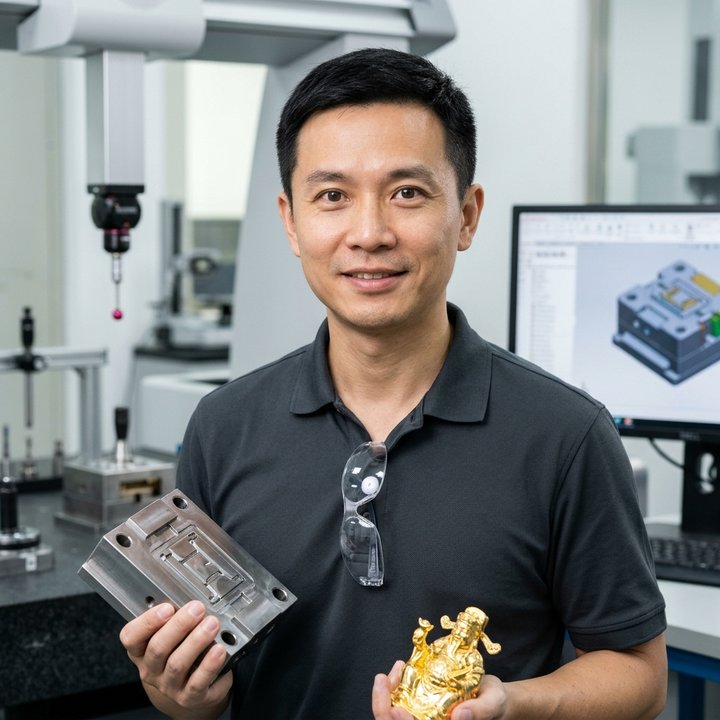
Verified Shop-Floor SOP • Quanzhou 35,000 m² Die-Casting & Plating Campus
Pick up a museum-grade Fabergé-inspired Imperial egg, a Victorian rose engagement-ring box, or a jeweled sea-turtle keepsake box inside a Fifth Avenue department store or palace gift shop, and perform the three-second buyer test that every luxury merchandiser knows by heart. First, inspect the equatorial mouth seam running 360 degrees around the closed shell under overhead spotlighting. Second, lift the upper lid with one fingertip to feel the initial magnetic breakaway resistance and check whether the hinge swings upward with silky, zero-play precision or rattles side-to-side like a loose barn door. Third, brush your thumb firmly across fifty pavé-set faceted crystals and inhale inside the velvet-lined cavity to verify zero chemical solvent odor.
Among all five core product families we manufacture at ArtisZinc Metalcrafts Co., Ltd., hinged enameled zinc alloy trinket boxes demand the highest level of multi-disciplinary coordination between hot-chamber foundry physics, precision post-cast CNC fixture machining, jewelry-grade hand enameling, and cleanroom micro-assembly. Unlike a one-piece keychain or medallion, a hinged keepsake box is a mating two-shell mechanical instrument. If the upper lid casting shrinks 0.18% differently than the thicker pedestal base casting during cooling, the two halves will rock like a warped clamshell, leaving an unsightly 0.9 mm gap at the front clasp while binding tight at the rear hinge! Over my eighteen years leading tooling and assembly operations at ArtisZinc, we have refined a deterministic engineering workflow that holds closed equatorial seam gaps strictly under 0.15 mm across oval, octagonal, heart-shaped, and organic animal silhouettes. Here is how every tolerance is controlled on our shop floor.
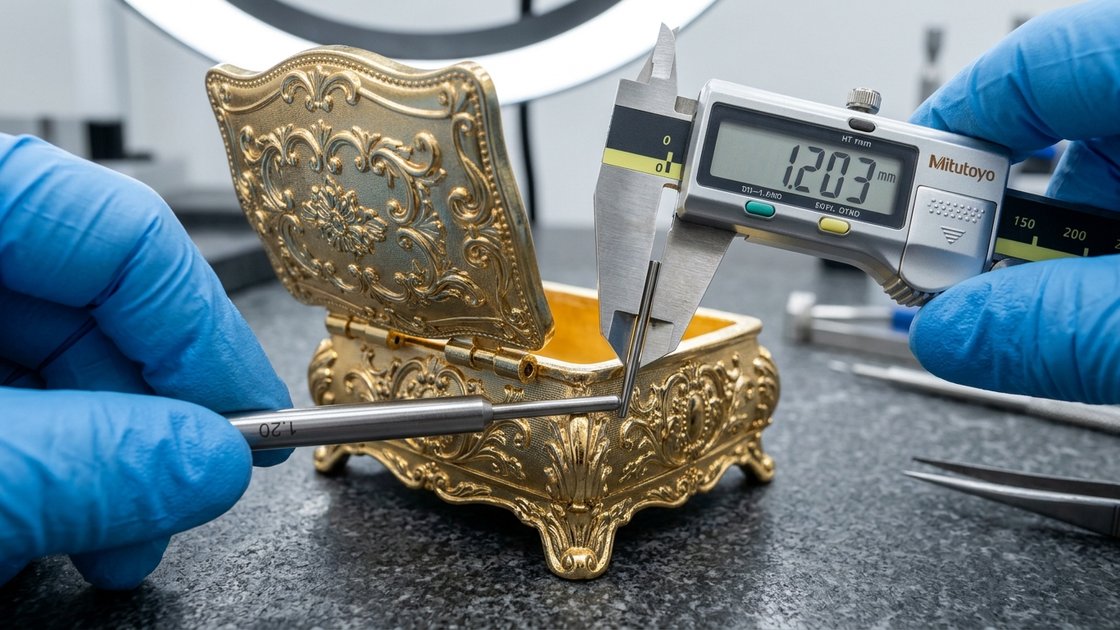
1. Thermal Shrinkage Compensation (0.6%–0.7% Linear Zamak-3 Contraction) Across Asymmetric Lid & Base Shells
Why do amateur gift factories struggle endlessly with oval egg boxes and sculpted animal boxes whose lids overhang the base on the left side while falling short on the right? Because they scale both the upper lid CAD cavity and the lower base CAD cavity by a single uniform textbook shrinkage factor—typically 0.65% (0.0065 mm/mm)—without accounting for wall-thickness thermal mass asymmetry and core-restraint anisotropy.
Consider a classic 85 mm tall Fabergé-style hinged egg standing on three ornate Baroque tripod legs. The upper dome lid is a thin, hollow hemisphere with a uniform 1.85 mm wall thickness that cools rapidly and contracts freely inward toward its center once ejected from the steel core at 195°C. Conversely, the lower base half integrates thick 5.5 mm decorative tripod legs, a heavy internal magnet boss, and a thick pedestal ring. Because the base contains 65% more thermal mass and grips tightly around the stationary steel cavity core for an extra 1.8 seconds before ejection, steel core restraint restricts radial contraction along the major oval axis while allowing greater free thermal contraction after ejection!
1. Compensated Steel Cavity Dimension: Dsteel(x,y) = Dnominal(x,y) · [1 + Sfree - Krestraint · (tcore_dwell / hwall)] + 2 · tplating
• Where virgin Zamak-3 free linear shrinkage Sfree = 0.0067 (0.67%), core restraint factor Krestraint calibrated per aspect ratio, and rack plating stack-up tplating = 0.022 mm per wall
2. Self-Centering Rabbet (Step-Lip) Rim Clearance:
• Inner locating pilot skirt height Hpilot = 1.40 mm with 3° lead-in chamfer; radial pilot clearance Cradial = 0.08 mm ± 0.03 mm post-plating; exterior equatorial seam gap Gseam ≤ 0.15 mm
Notice two critical geometric tricks built into that formula. First, instead of letting two flat butt-end walls meet edge-to-edge—where any 0.10 mm shift exposes dark interior shadow—we machine an interlocking stepped rabbet pilot lip (watch-case bezel joint) around the mouth of the lower base that nests inside a matching counterbore inside the upper lid! That hidden 1.40 mm pilot step visually blocks light pass-through even before full closure while mechanically guiding the lid onto dead-center alignment every single time the user shuts the box.
Second, we machine the H13 steel rim shut-off inserts slightly "steel-safe" by 0.06 mm for our T0 first-article trial shot, measure thirty cooled castings after 24 hours of room-temperature dimensional stabilization on our Brown & Sharpe CMM (Coordinate Measuring Machine), and perform a single 5-micron high-speed EDM skim pass so lid and base rims match like a Swiss pocket watch before a single gram of gold plating is applied.
2. ±0.03mm Three-Knuckle Hinge Coaxiality & 10,000-Cycle SUS304 Knurled Pin Engineering
On a hinged trinket box, the rear knuckle joint carries the entire cantilevered overturning moment when the heavy lid swings back against its 95°–105° mechanical open stop. Low-end workshops cast rough holes directly via tiny sliding core pins in the die-casting mold and shove a smooth, soft brass wire straight through the plated holes, pinching the ends with pliers. Within fifty openings, two failures ruin the piece: plating buildup inside the un-reamed cast hole flakes off as black grit, and the soft brass wire bends by 0.2 mm—causing the lid to twist diagonally so the front magnetic clasp misses its strike plate!
At ArtisZinc, we engineer a concealed three-barrel (two outer base knuckles + one central wide lid knuckle) precision-reamed hinge:
- Post-Cast Dedicated Pneumatic Line-Reaming Jig: Rather than relying on tapered cast holes (which always require a 1.5° draft taper to pull steel pins out of molten zinc!), we cast pilot starter dimples and mount the mated lid-and-base pair into a custom urethane-nest pneumatic fixture. A solid-carbide step-reamer spinning at 2,800 RPM line-bores all three barrels simultaneously in one single stroke—guaranteeing true cylindrical bore geometry (∅1.60 mm +0.02/+0.00 mm) and coaxial alignment within ±0.03 mm!
- One-End Diamond-Knurled Hardened SUS304 Stainless Pivot Pin: We never use soft brass wire or rust-prone carbon steel pins. Our CNC Swiss-lathe pins are turned from cold-drawn SUS304 austenitic stainless steel (≥ 680 MPa tensile strength) featuring a precision 2.5 mm micro-knurled press-fit zone at one blind end and a mirror-burnished journal shaft across the center lid barrel. Pressing the pin into a blind-ended outer barrel locks the knurl permanently inside the base casting while leaving the opposite outer cheek completely seamless—zero ugly exposed pin holes visible from the left side of the box!
- Integrated 102° Over-Center Mechanical Stop Shoulder: When opened past 90°, the rear bevel of the upper lid gently kisses a cast mechanical stop shelf at 102°–105°, allowing the open trinket box to stand stably on a vanity dresser displaying a ring inside without tipping backward or straining the hinge pin.
3. Calibrating Hidden Magnetic Closure Damping: The 3.5 N to 5.0 N Luxury "Click"
Have you ever tried to open a small keepsake box whose magnet was so excessively strong that you had to pry your fingernails into the seam—causing the whole box to jump out of your fingers when it finally popped open? Or worse, picked up a gift box by its lid only to have the bottom half drop onto the floor because the magnet was too weak?
Luxury tactile ergonomics comes down to calibrating breakaway snap force strictly within the 3.5 N to 5.0 N (360 gf to 510 gf) goldilocks window. In a 110-gram trinket box where the lower base weighs 65 grams, a 3.5 N minimum closure force provides a 5.5x safety margin if a customer lifts the box by its lid, while staying effortless to open one-handed without prying fingernails.
How do we prevent brittle sintered magnets from chipping each other after 5,000 hard metallic slams? We cast twin opposing cylindrical wells at the 12-o'clock front lip of the lid and base, bond high-stability ∅3.0 mm × 2.0 mm Ni-Cu-Ni coated N42/N45 NdFeB or SmCo magnets using toughened structural epoxy, and recess both magnet faces 0.08 mm below the surrounding gold-plated rim pilot step! Because the two magnet poles halt across a controlled 0.16 mm air gap right as the metal rim step seats home, magnets never smash crystal-to-crystal—delivering a muted, watch-box mechanical click with zero magnetic chipping for decades.
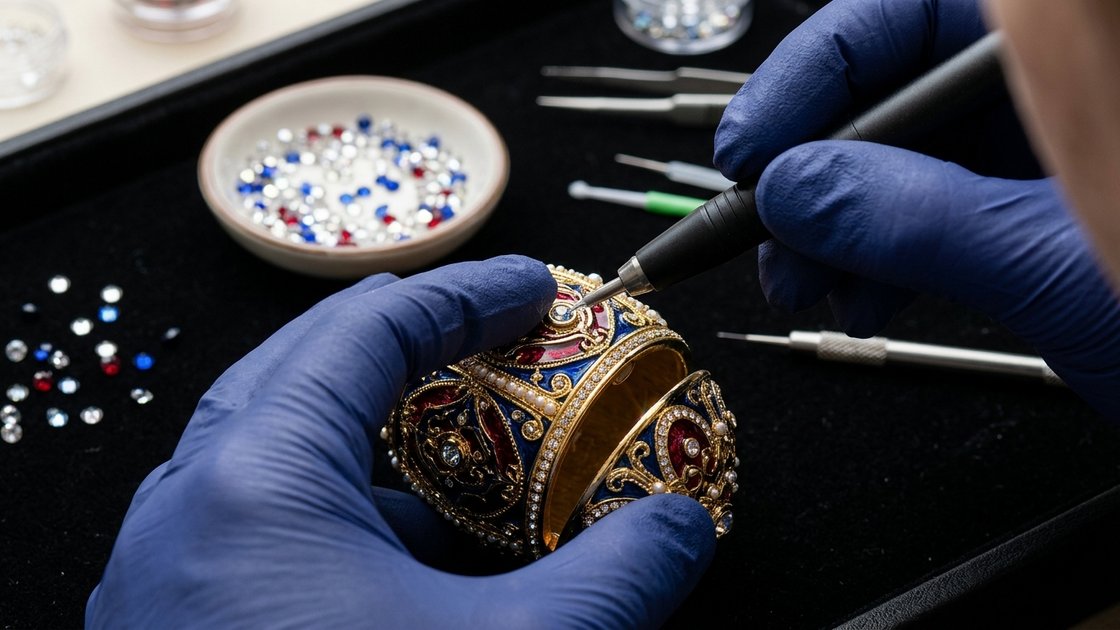
4. Translucent Kiln-Baked Gradient Enameling & Zero-Drop Czech Crystal Setting
What elevates an heirloom enameled trinket box from $8 tourist kitsch to a $65–$120 museum collectible is optical depth: shimmering guilloché-style engine-turned rays radiating beneath translucent emerald, sapphire, or ruby enamel accented by brilliant-cut crystal stones.
Multi-Tone Shaded & Pearlescent Translucent Enameling
To recreate authentic Imperial guilloché wave patterns without hand-turning individual silver blanks, our 5-axis laser-engraving center etches 0.06 mm deep concentric moiré sunburst reliefs directly into the hardened H13 steel mold cavity. Once cast in virgin Zamak-3 and electroplated in bright 24K gold or rhodium silver, our master enamelers dispense two or three compatible viscosities of translucent jewel-tint and mica-pearlescent cycloaliphatic baking enamels—wet-blending pale champagne gold at a rose petal's center smoothly into deep burgundy at the petal tip using fine sable-hair needles before kiln-curing at 130°C for 95 minutes in HEPA-filtered positive-pressure ovens (Class 10,000 cleanroom dust control so zero airborne lint specks ever mar glossy curved shells).
Why Cheap Rhinestones Cloud Over or Fall Out—And How We Fix Both
Every gift importer has seen cheap jeweled boxes arrive with dead, milky-looking stones or loose crystals rattling inside the gift box. Two workshop blunders cause this:
- Eliminating Cyanoacrylate "White Frosting" (Blooming): If a worker dots ordinary one-part super glue into a stone cup, volatilized cyanoacrylate monomer vapor condenses across the faceted crown of the crystal and reacts with ambient humidity to form permanent chalky white frost—killing refractive fire instantly! Worse, ordinary super glue attacks the silver/aluminum vacuum-foiled mirror backing on the underside of flat-back stones, turning bright crystals dull gray within weeks.
- ArtisZinc's Conical Cup + Foil-Safe Dual-Cure Optical Epoxy Standard: First, we never glue flat-back stones onto flat surfaces; we cast dedicated conical V-bottom stone bezels (cup depth = 55% of crystal girdle height, rim wall ≥ 0.28 mm) matched to machine-cut 12-facet and 16-facet lead-free Czech Preciosa or Grade-AAAAA K9 optical glass chatons (strictly <20 ppm Pb for CPSIA/Prop 65 compliance!). Second, pneumatic micro-dispensers place a nanoliter droplet of 100% solids, zero-VOC, foil-safe modified optical epoxy into each cup. Vacuum pick-and-place pens seat each chaton level within ±3°, followed by UV tack-pinning and a 95°C thermal post-cure. Every stone survives a 12 N lateral brass-stylus shear push test and 15 minutes of ultrasonic cleaning without loosening or clouding!
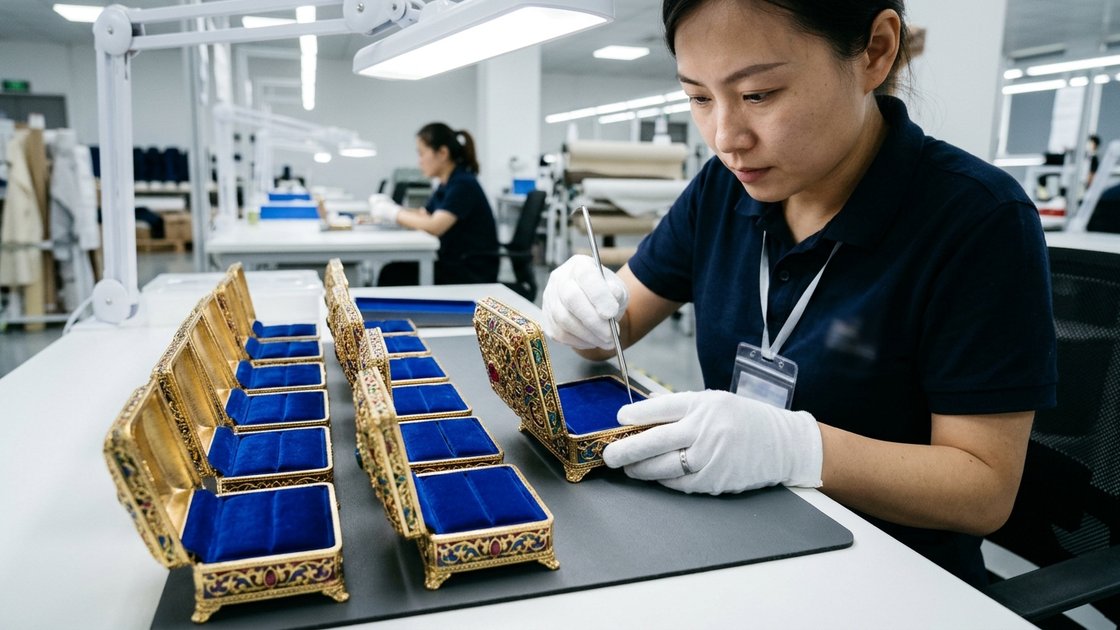
5. Anti-Tarnish Zero-VOC Velvet Lining & Ring-Cushion Interior Craftsmanship
Open the lid of an ArtisZinc trinket box and the interior receives just as much engineering attention as the exterior shell. Depending on your retail price tier and interior geometry, we execute three distinct interior finishes:
- Mirror Gold or Pearl-Enamel Glazed Interior: Ideal for organic sea-life, animal, and miniature egg shapes—the interior bowl is polished smooth, bright-plated in 24K gold or champagne silver, and coated in glossy cream or metallic pearl kiln enamel stamped with your brand's backstamp hallmark in crisp laser or pad-printed gold leaf.
- Electrostatic Zero-VOC Micro-Rayon Velvet Flocking: For intricate contoured cavities, waterborne odorless acrylic flocking adhesive is masked onto the interior walls while a 45 kV electrostatic field shoots 0.8 mm dyed nylon/rayon micro-fibers vertically at 90 degrees into the wet film—creating a seamless, plush suede carpet into every corner with zero glue smell.
- Die-Cut Thermoformed Velvet Tray + High-Density PU Foam Ring Roll: For engagement-ring, earring, and rosary keepsake boxes, we bond laser-cut, anti-tarnish sulfur-free royal velvet (passing silver-strip tarnish acceleration per ASTM B809 so customers' sterling silver rings never turn black inside!) using odorless water-based hot-press film.
6. Shop-Floor SOP: 7-Stage Quality Control Matrix for Hinged Trinket Boxes
| Inspection Gate | Critical Tolerance & Target Spec | Measuring Instrument / Standard | Sampling & Reject Disposition |
|---|---|---|---|
| Gate 1: Rim Shrinkage & Shell Match | Equatorial closed seam gap ≤ 0.15 mm all around; radial lip step mismatch ≤ 0.08 mm | CMM + Pin Feeler Gauge + Backlit Light Box | 30 pcs at T0 mold tune + 100% tactile/visual shell pairing post-trim |
| Gate 2: Line-Ream & Pin Coaxiality | 3-knuckle coaxiality ±0.03 mm; blind SUS304 knurled pin press retention ≥ 85 N; 102° stop | Carbide Go/No-Go Plug Gauge + 10,000-Cycle Pneumatic Hinge Tester | 5 pcs per batch run 10,000 cycles; 100% manual swing smoothness & zero-wobble check |
| Gate 3: Plating & Salt-Spray Shield | 24K Gold / Antique Pewter + 10 μm E-coat; 72h–96h ASTM B117 neutral salt spray pass | XRF Thickness Meter + Salt-Spray Fog Cabinet | Witness shells per rack shift; zero tarnish, peel, or inner-cavity acid stain |
| Gate 4: Cleanroom Gradient Enamel | Zero dust inclusions > 0.08 mm in Class 10,000 oven; smooth shade blend to Golden Sample | 10x Stereo Loupe under D65 Daylight Booth | 100% pre-stone inspection before advancing to crystal cleanroom |
| Gate 5: Crystal Shear & Thermal Shock | Zero missing, crooked, or frosted chatons; lateral stone shear ≥ 12 N; -15°C to +60°C 5 cycles | Calibrated 12 N Brass Push Probe + Thermal Chamber | 100% stone count & stiff-bristle brush sweep test + 10 pcs thermal shock audit |
| Gate 6: Magnetic Snap & Velvet Odor | Opening breakaway force 3.5 N – 5.0 N; zero VOC solvent odor (VDA 270 Rating ≤ 2.5); anti-tarnish | Digital Force Gauge + Sealed 40°C Jar Olfactory Panel | 20 pcs pull-force logged per batch + 100% snap closure test during velvet kitting |
| Gate 7: Satin Gift-Box Drop & XRF | Pb < 20 ppm, Cd < 10 ppm across alloy, enamel & crystals; satin-lined rigid gift box 1.0 m drop | Benchtop XRF (Prop 65 / CPSIA / REACH) + ISTA 1A Drop | Signed multi-component XRF CoA + white outer protective sleeve per gift box |
7. Integrating 18-Note Mechanical Musical Movements & Satin-Cradle Export Packaging
For palace museums, opera houses, and holiday department-store collections, adding a wind-up 18-note Sankyo-grade mechanical musical comb inside a large hinged Fabergé egg or carousel trinket box elevates retail value from $65 to $145+. From a mechanical engineering standpoint, die-cast Zamak-3 makes a phenomenal acoustic resonance chamber—provided the movement chassis is bolted directly onto three CNC-tapped M2.0 internal Zamak bosses using brass machine screws rather than glued onto velvet! Direct metal-to-metal acoustic coupling transfers comb vibrations straight into the heavy zinc shell, amplifying chime warmth and volume by +8 dB compared to hollow plastic housings while letting a concealed bottom wind-up key sit flush beneath felt tripod feet.
Finally, an heirloom enameled crystal box is only as safe as its individual gift-box cradle. Standard die-cut cardboard inserts scuff glossy enamel during ocean transit. Every ArtisZinc trinket box rests inside a custom-molded satin-draped high-density EVA cavity housed within a 1,200 gsm rigid two-piece presentation box—holding the piece suspended by its structural waist so zero shipping shock ever touches delicate flower petals, tripod legs, or crystal crowns during 1.0-meter ISTA 1A drop testing.
Engineering Floor Q&A: Custom Enameled Hinged Trinket & Jewelry Boxes
Q1: Why must crystal chatons on US and European trinket boxes be explicitly specified as "Lead-Free Optical Crystal" rather than traditional 30% leaded crystal?
Marcus Lin: Classic European full-lead crystal glass historically used 24% to 32% lead oxide (PbO) to raise refractive index—which translates to 240,000+ ppm lead! Under US CPSIA (children's keepsakes ≤ 100 ppm total Pb) and California Proposition 65 settlements for decorative giftware, leaded glass chatons trigger immediate lab failures and recall notices. ArtisZinc exclusively installs precision machine-cut barium/titanium/potassium high-refractive lead-free Czech and Grade-AAAAA optical crystals (<20 ppm Pb) that deliver virtually identical diamond-like dispersion while passing every XRF gun in US and EU retail compliance labs.
Q2: Can a tall Fabergé egg or high-heeled shoe trinket box pass tip-over stability tests when the lid is swung open?
Marcus Lin: That is one of the first checks our Siemens NX CAD software runs before we cut steel! We compute the 3D Center of Gravity (CG) of the assembly in both closed and 102°-open positions. If a slender top-heavy sculpt shifts the open CG too close to the rear tripod footprint edge, we thicken the hidden internal floor of the lower pedestal base by 2.5–3.5 mm of solid Zamak-3—lowering the center of gravity cleanly inside the stability triangle without altering exterior proportions.
Q3: Can you include matching miniature pendant necklaces hidden inside hinged egg or animal keepsake boxes?
Marcus Lin: Yes—two-piece "Surprise Necklace Inside" gift sets are one of our most popular museum and botanical-garden holiday items. We cast a coordinating miniature enameled charm hung on an 18-inch REACH/Prop 65 compliant plated brass or SUS316L stainless chain, nestled neatly inside a custom-slotted velvet cushion inside the trinket box and packaged in a foil-stamped satin-lined rigid presentation box.
Q4: How do you apply custom museum or luxury brand hallmarks inside small curved trinket boxes?
Marcus Lin: We offer three permanent hallmark methods: casting raised or sunken 0.35 mm crisp relief hallmarks directly into the steel mold floor under the base, precision rotary fiber-laser engraving serial edition numbers (`Edition 001/500`) inside the gold-plated rim lip, or hot-stamping metallic gold foil onto the interior satin lid pillow.
Q5: What are your MOQs, prototyping timelines, and custom mold costs for sculpted 3D trinket boxes?
Marcus Lin: Because a hinged trinket box uses dedicated upper-lid and lower-base cavities (often with side slides for undercut petals or legs), custom H13 steel tooling typically runs $1,350 to $2,200 depending on size—with a 500-piece custom MOQ and 100% mold fee refund at 5,000 cumulative units! If you want to test retail sell-through with only 200 pieces, you can customize enamel palettes, crystal layouts, and custom bottom/interior brand hallmarks on our existing library of classic egg, heart, round floral, and coastal marine molds. Send a sketch or reference photo to [email protected] for a 48-hour 3D hinged prototype and full cost breakdown. Every production order includes signed Golden Sample retention units stored in our quality room so repeat holiday seasons match your exact enamel shade and magnetic snap feel.
Need a Free 12-Hour Mold-Flow & Plating Review on Your Design?
Send your 2D vector art or 3D STEP/STL sculpture directly to Marcus Lin's tooling desk for wall-thickness, draft-angle, and cost-tier optimization.
More Peer-Reviewed Metallurgical & Tooling Whitepapers
- → Zamak-3 vs. Zamak-5 in Heavy Bottle Openers: Jaw Shear Mechanics, Porosity Control & 45 N·m Torque Testing (Bottle Opener Metallurgy • 14 min read)
- → Hard Enamel Cloisonné vs. Recessed Soft Enamel Keychains: Lapping Tolerances, 0.15mm Metal Dam DFM & Split-Ring Fatigue (Keychain Craft & Enameling • 14 min read)
- → Engineering Zero-Drop 3D Souvenir Fridge Magnets: Recessed N52 Neodymium Bonding, Coastal Salt-Fog Defense & Multi-Layer Riveting (Souvenir Fridge Magnets • 14 min read)
- → Sculpting 28mm–75mm Die-Cast Zinc Alloy Figurines: Four-Slide Core Pulls, Invisible Parting Lines & Centrifugal vs. Steel Tooling (Metal Figurines & Miniatures • 14 min read)
- → Passing ASTM B117 96-Hour Salt Spray & California Prop 65 on Custom Zinc Alloy Gifts: Duplex Plating, Nickel-Free Finishes & XRF Gatekeeping (Surface Finishing & Compliance • 14 min read)