Hard Enamel Cloisonné vs. Recessed Soft Enamel Keychains: Lapping Tolerances, 0.15mm Metal Dam DFM & Split-Ring Fatigue
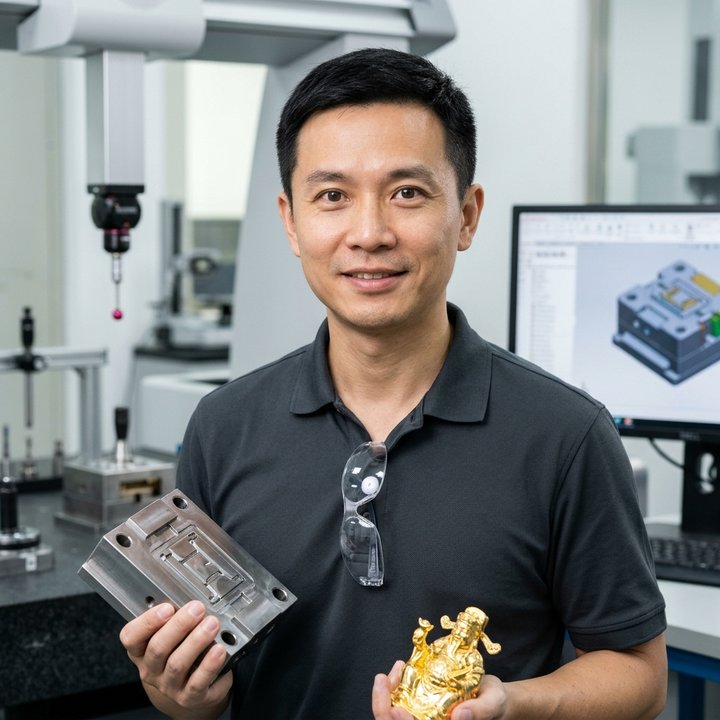
Verified Shop-Floor SOP • Quanzhou 35,000 m² Die-Casting & Plating Campus
Every week at ArtisZinc Metalcrafts Co., Ltd., our quoting inbox receives at least half a dozen vector PDFs created by talented graphic designers who treat molten zinc and liquid enamel like infinite-resolution Adobe Illustrator pixels. A typical file shows an intricate automotive crest or esports mascot reduced down to a 38 mm keychain medallion, packed with forty-seven microscopic color pockets separated by 0.06 mm hairline strokes, accompanied by a single note on the purchase order: "Must be durable Hard Enamel—do NOT use soft enamel because we don't want the paint to scratch off with a fingernail!"
That single sentence reveals the two biggest misconceptions in promotional and retail metal keychain sourcing. First, modern commercial "hard enamel" (technically termed imitation hard enamel, synthetic Cloisonné, or Epola in our craft trade) and "soft enamel" cure to almost identical Shore D surface hardness once properly kiln-baked; neither one can be scratched off with a fingernail when formulated and cured correctly. What actually differentiates them is reverse manufacturing process sequence, flat carborundum stone lapping, final meniscus cross-section, and unit labor cost. Second, true vitreous glass Cloisonné—fired at 780°C to 830°C using powdered silica frit—can only be fused onto high-melting-point red copper or gilding metal, because ASTM B240 Zamak-3 zinc alloy melts completely at 381°C–387°C! Understanding how we engineer synthetic hard enamel versus recessed soft enamel on die-cast Zamak-3 substrates will save your team weeks of artwork revisions, prevent ugly color bleed in acute corners, and eliminate pocket-keychain hardware failures.
1. Reverse Process Sequencing: Why Hard Enamel Plates LAST While Soft Enamel Plates FIRST
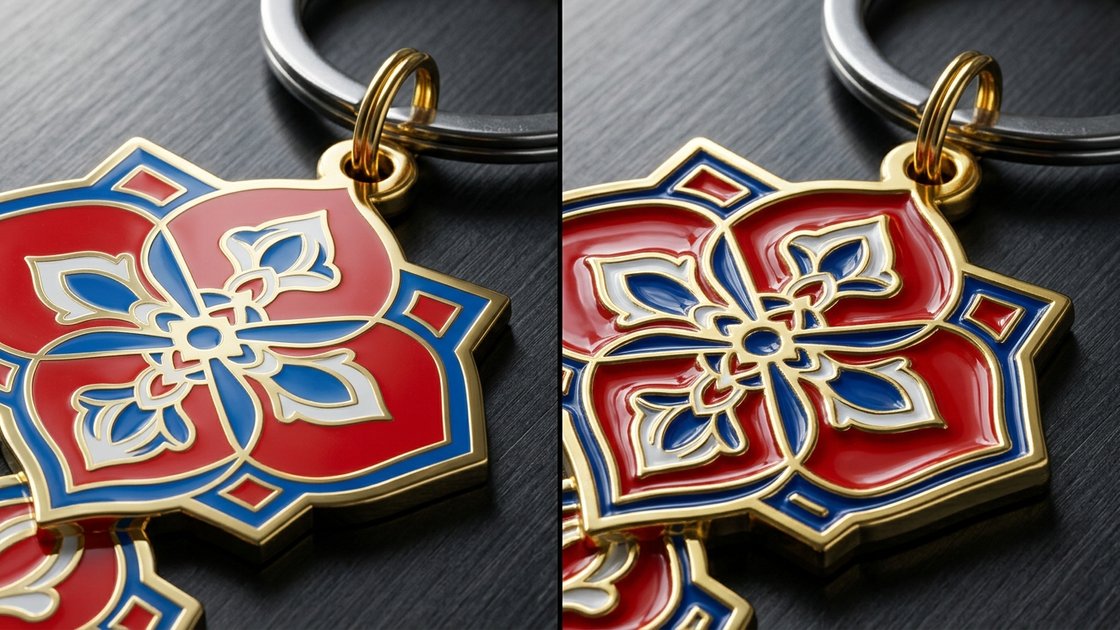
If you hold an ArtisZinc imitation hard enamel keychain in your left hand and a recessed soft enamel keychain in your right hand with your eyes closed, your thumb tells them apart instantly. Across the hard enamel keychain, the colored resin surfaces and the polished gold or nickel metal lines sit in one continuous, glass-smooth flush plane—like inlaid marble jewelry. Across the soft enamel keychain, your fingertip feels crisp, raised metal ridges framing tactile recessed valleys of glossy color sitting 0.20 mm to 0.30 mm below the metal crests.
Achieving those two distinct tactile profiles requires fundamentally inverted factory routing on our production floor, which explains why imitation hard enamel carries a 22% to 35% higher unit price and an extra two days of floor cycle time:
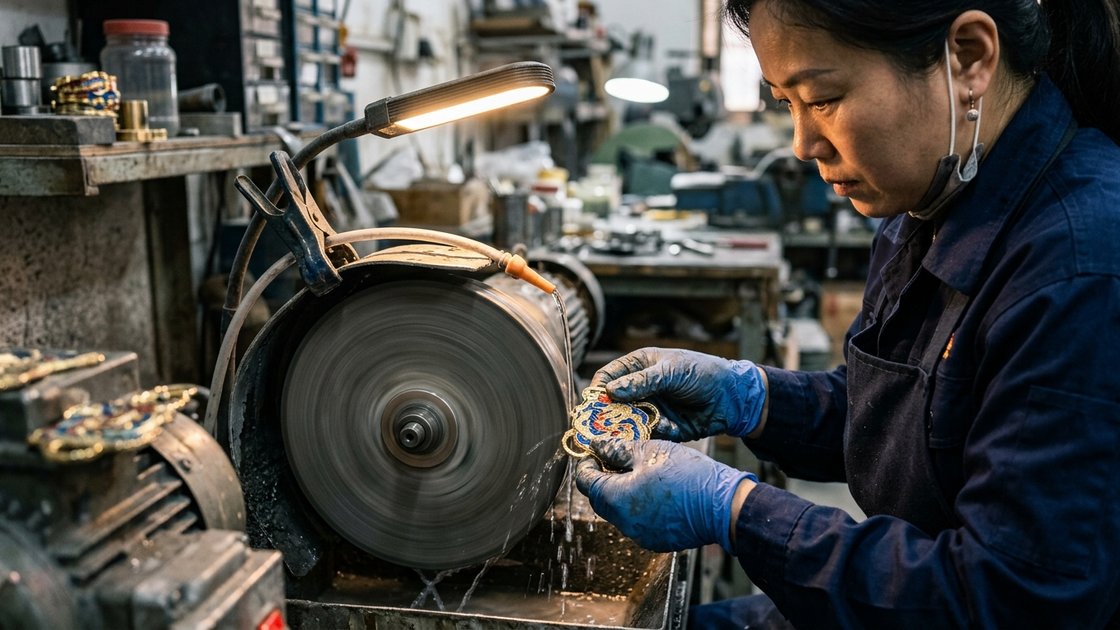
- Imitation Hard Enamel (Color First → Bake → Multi-Stage Wet Lapping → Electroplate Last): Immediately after die-casting, gate trimming, and vibratory pre-smoothing, the unplated bare Zamak-3 keychain enters our syringe-dispensing cleanroom. Technicians overfill every recessed cell slightly proud of the metal walls using high-solids modified cycloaliphatic epoxy-resin paste matched to Pantone Solid Coated chips. Each color stage cures in convection ovens at 185°C to 195°C for 35 to 45 minutes (or stepped multi-bake cycles when adjacent colors require sequential masking). Once cured rock-hard (Shore D 82–86), the raw dome-topped casting moves to water-cooled carborundum grinding stations (#400 coarse leveling → #800 intermediate smoothing → #1500 ultra-fine wet lapping) followed by cotton-wheel Tripoli and white-rouge buffing until every single metal septum dam emerges flush and mirror-bright amidst flat islands of color. Only after lapping does the keychain enter our ultrasonic cleaning and rack electroplating line, where copper, nickel, and gold deposit strictly onto the exposed conductive zinc lines without touching the non-conductive cured resin!
- Recessed Soft Enamel (Buff → Electroplate First → Syringe Fill Below Rim → Low-Temp Bake): Here, the bare Zamak-3 casting is polished and electroplated first to its final mirror gold, black nickel, satin silver, or antique brass finish. Plated castings then move to pneumatic micro-needle dispensing tables (or 4-axis CNC XYZ robotic dispensers for high-volume SKUs), where catalyzed baking enamel is metered precisely into each recessed cavity so capillary wetting forms a concave meniscus sitting 0.22 mm to 0.28 mm below the top of the plated metal dam. Castings then bake at 130°C to 140°C for 90 minutes—deliberately kept below 145°C so bright gold or antique platings never suffer thermal discoloration or chromate crazing.
| Engineering & Aesthetic Dimension | Imitation Hard Enamel (Synthetic Cloisonné) | Recessed Soft Enamel (Textured Relief) | Soft Enamel + Optical PU Epoxy Dome |
|---|---|---|---|
| Factory Process Sequence | Cast → Fill → Bake → #400/#800/#1500 Lap → Plate | Cast → Polish → Electroplate → Fill → Low Bake | Cast → Plate → Fill → Bake → UV-Stable PU Dome |
| Curing Thermal Profile | 185°C – 195°C (Pre-plating bare Zamak-3) | 130°C – 140°C (Post-plating thermal safe) | 135°C Enamel + 65°C Dust-Free Dome Cure |
| Final Surface Cross-Section | Flush within ±0.015 mm; jewelry-grade flat sheen | 0.22 – 0.28 mm recessed concave color valleys | 1.1 – 1.4 mm clear convex protective lens |
| Minimum Metal Dam Top Width | 0.18 mm – 0.22 mm (Must survive stone grinding) | 0.15 mm minimum (No post-fill grinding wear) | 0.15 mm minimum |
| Compatible Finishes | Shiny Gold, Silver, Nickel, Black Nickel, Rose Gold | All Shiny + Antique Brass/Copper/Pewter, Matte Black | All Plated & Silkscreen Overprint Finishes |
| Shore D Cured Hardness | 82 – 86 Shore D | 76 – 80 Shore D | 80 Shore D base + Self-healing 65 Shore D dome |
Notice a critical metallurgical rule hidden in row five of that table: if your keychain design calls for distressed Antique Brass, Antique Bronze, or Antique Pewter with dark recessed oxidation wash, you should almost always specify Recessed Soft Enamel rather than Hard Enamel. Why? Because antique finishes rely on immersing a plated piece into a chemical oxidizing sulfide/selenium bath and mechanically relieving the high spots to leave dark contrast tucked down inside valleys. On a flat-lapped hard enamel piece, there are no recessed valleys left—so mechanical relieving wipes the antique patina irregularly off the flush metal lines while risking chemical staining around white or pastel resin borders.
2. Lapping Tolerances & Preventing "Dished Resin" or "Ground-Through Septums"
Flat-lapping a 3D contoured or multi-level keychain in imitation hard enamel is where amateur shops ruin 25% of a batch. Cured epoxy-resin has an elastic modulus roughly one-twentieth that of Zamak-3 zinc alloy (approx. 3.8 GPa vs. 96 GPa). If an operator presses a keychain too aggressively against a soft, worn foam-backed sanding belt, or skips directly from #320 grit to cotton buffing wheels, two defects appear immediately under oblique inspection lighting:
- Abrasive Dish-Out (Undercutting): Soft cotton buffing wheels loaded with coarse Tripoli compound scoop out the softer resin faster than the surrounding zinc metal dams, creating wavy "orange-peel depressions" across broad color fields greater than 8 mm wide. At ArtisZinc, we prevent dish-out by performing 92% of material removal on rigid, diamond-trued water-cooled flat platen wheels stepping strictly through #400, #800, and #1500 silicon carbide / carborundum stages with less than 15 N contact pressure, reserving ultra-short 4-second white-rouge polishing solely to restore luster before plating.
- Wall Taper Widening & Dam Breakthrough: Because die-cast mold cavities require a draft angle so the solidified zinc keychain ejects cleanly off the H13 steel core without dragging, every raised metal septum line is actually a microscopic trapezoid—narrower at the top crest and wider at its base. If a clumsy grinder removes 0.35 mm of vertical metal height instead of our target 0.08 mm to 0.12 mm lapping allowance, a crisp 0.18 mm letter stroke balloons into a clumsy, uneven 0.32 mm blob—or worse, grinds completely through an outer relief step!
3. 0.15mm Metal Dam DFM, Capillary Bleed Physics & Minimum Recessed Cell Geometry
Let us look directly at the physics of why colors bleed across lines or leave microscopic pinholes in sharp corners—like the tips of stars, wolf teeth, or serif typography—on custom zinc alloy keychains. Liquid enamel dispensed from a 27-gauge stainless steel micro-needle (inner orifice 0.21 mm) has a dynamic viscosity between 1,800 and 3,500 cP prior to thermal gelation. Inside a miniature recessed pocket, capillary pressure ΔP governed by the Young-Laplace relationship dictates whether liquid pigment climbs over a metal dam or refuses to enter a tight vertex.
1. Dam Base Width: Wbase = Wcrest + 2 · dcavity · tan(θdraft)
• Soft Enamel Minimums: Wcrest ≥ 0.15 mm, Cavity Depth dcavity = 0.75 – 0.90 mm, Draft θdraft = 7°
• Hard Enamel Minimums: Wcrest ≥ 0.20 mm (pre-lap 0.17 mm + 0.03 mm lap flat), dcavity = 0.85 – 1.00 mm
2. Minimum Enclosed Color Cell Width: Wcell ≥ 0.35 mm with internal corner fillet radius Rvertex ≥ 0.15 mm
3. Split-Ring Boss Shear Tear-Out Safety: tboss-wall ≥ 1.85 mm around ∅3.2 mm jump-ring aperture
When a graphic designer sends vector art containing a 12-degree acute star point tapering down to zero width, two shop failures are guaranteed if an engineer blindly CNC-engraves that vector straight into steel:
- Even a 0.10 mm solid carbide pyramidal engraving bit spinning at 36,000 RPM on our Makino high-speed milling center cannot cut an infinitely sharp zero-radius internal pocket; furthermore, trapped air inside a 0.12 mm narrow wedge prevents viscous resin from wetting the bottom corner, leaving a permanent dark void bubble after baking.
- Conversely, if the technician increases pneumatic syringe pressure to force pigment into that micro-wedge, excess fluid surges upward along the corner meniscus and spills straight across an undersized 0.08 mm metal wall into the neighboring white cell—creating cross-color bleed!
During ArtisZinc's complimentary 24-hour DFM conversion, we never ask non-technical clients to redraw their own files. Our CAD engineers overlay a translucent DFM layer onto your artwork: expanding sub-threshold hairlines cleanly to 0.15 mm (soft enamel) or 0.20 mm (hard enamel), opening cramped color wedges to at least 0.35 mm, and shifting microscopic gradient details or 0.08 mm copyright text onto precision UV silkscreen / pad-printed overprint layers cured directly atop smooth hard enamel or epoxy domes! That hybrid technique—combining die-cast hard enamel base blocks with 1,200 dpi silkscreen micro-linework—is exactly how luxury theme parks and anime studios achieve museum-grade character eyes on 45 mm keychains.
4. Solving the #1 Hardware Failure: Split-Ring Elastic Fatigue & Jump-Ring Pull-Out
Ask end consumers why they eventually throw away a branded keychain and nine times out of ten the medallion itself looks great—what failed was the cheap mild-steel split ring that yawned permanently open after sliding onto a thick car-fob loop, or an un-welded wire jump ring that pulled apart at 6 kgf when snagged on a backpack strap.
A keychain attachment assembly consists of three mechanical links: the cast Zamak-3 top eyelet boss on the medallion, the intermediate chain/jump-ring connector (or swivel lobster clasp), and the 25 mm to 32 mm coiled split key ring. Low-end promotional vendors cut $0.03 per piece by pairing low-carbon iron wire rings plated in flash nickel with open-butted 1.0 mm iron jump rings. The moment someone wedges a thick 3.2 mm automotive fob tab between the coils of a low-carbon iron split ring, the bending strain exceeds the wire's low elastic limit, leaving an ugly 1.5 mm permanent gap ("fish-mouthing") that sheds keys inside a purse or pocket.
At ArtisZinc, our hardware engineering specification treats the attachment chain with the same metallurgical rigor as the medallion:
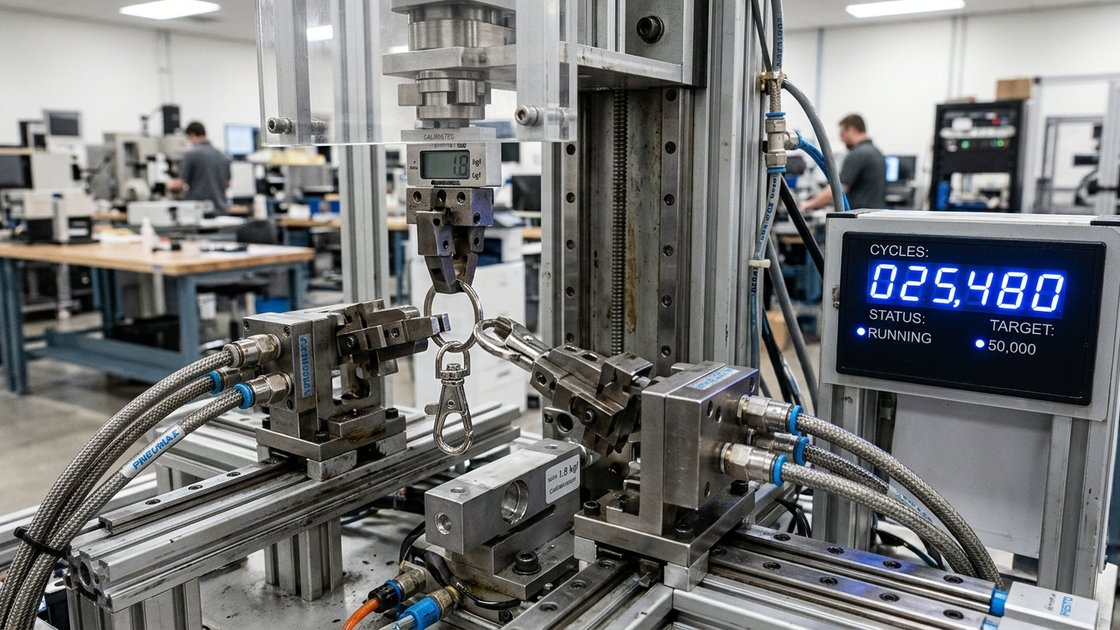
- Heat-Treated Fe-Mn Spring Steel (65Mn) or Cold-Worked SUS304 Flat Split Rings: We form flat-stamped double-coil split rings out of either cold-rolled SUS304 austenitic spring temper wire or oil-tempered 65Mn spring steel hardened to 42–46 HRC prior to rack plating and hydrogen baking relief. Every ring lot must survive a 3.0 mm steel wedge inserted 3,000 consecutive cycles and snap back with a residual coil gap strictly < 0.12 mm (tested with a pin feeler gauge—a sheet of 80 gsm copy paper barely slides in).
- 1.6 mm Wire-Gauge Butt-Welded or Heavy Figure-8 Links: Whenever total assembly pull rating must exceed 25 kgf (245 N)—surpassing ASTM F963 and EN71-1 small-parts tension abuse thresholds by nearly 3x—we eliminate thin 1.0 mm open jump rings entirely, specifying either laser-welded SUS304 jump rings, heavy 1.6 mm high-tensile tempered closed rings, or custom die-cast swivel dog-hooks with phosphor-bronze internal coil springs tested to 10,000 gate snaps.
- 1.85 mm Minimum Cast Eyelet Wall: We thicken the integrated loop boss at the top of the Zamak-3 charm to at least 2.2 mm axial thickness with a 1.85 mm radial wall surrounding a chamfered ∅3.2 mm hole, eliminating sharp cast burrs that otherwise saw through jump rings during pocket vibration.
5. Shop-Floor SOP: 7-Stage Quality Control Matrix for Custom Enamel Keychains
Whether we are producing 500 boutique museum gift-shop keychains or 80,000 serialized gaming collector drops, every work order follows our documented QC matrix:
| Manufacturing Gate | Engineering Tolerance / Target Spec | Test Apparatus & Standard | Inspection Frequency & Disposition |
|---|---|---|---|
| Gate 1: DFM & CNC H13 Cavity Engraving | Dam crest ≥ 0.15 mm (Soft) / ≥ 0.20 mm (Hard); Cavity depth 0.85 ± 0.05 mm; 7° draft | 3D Keyence Optical Measuring Microscope | 100% first-article steel electrode & T0 zinc shot scan before heat treat |
| Gate 2: Pantone Pigment Formulation | ΔE ≤ 1.2 against Pantone Solid Coated master book after full thermal cure | X-Rite Spectrophotometer under D65 Light Booth | Every mixed resin cup cured on metal test coupon prior to batch dispensing |
| Gate 3: Enamel Fill & Vacuum Degas | Zero air pinholes > 0.08 mm; zero cross-dam bleed; soft enamel meniscus -0.25 ± 0.04 mm | 10x Illuminated Magnifier Loupe + Vacuum Bell Jar | 100% in-line operator visual check prior to oven racking (wipe & refill wet rejects) |
| Gate 4: Stone Lapping (Hard Enamel Only) | Flush tolerance ±0.015 mm; zero dish-out or dam breakthrough across #400/#800/#1500 | Digital Indicator Gauge + Oblique Light Bar | AQL 1.0 audit post-#1500 wet wheel before ultrasonic pre-plate degreasing |
| Gate 5: Rack Electroplating & Salt Fog | Adhesion 5B (ASTM D3359); 72h–96h ASTM B117 neutral salt spray zero red/white rust | Salt-Spray Chamber + XRF Coating Thickness Analyzer | 3 witness pcs per plating tank shift + 100% visual color uniformity check |
| Gate 6: Hardware Fatigue & Tensile Pull | Axial assembly pull ≥ 25 kgf (245 N) for 10 sec; split-ring gap < 0.12 mm after 3,000 cycles | Motorized Push-Pull Force Stand (ASTM F963 / EN71-1) | 15 pcs destructive/functional sample per 2,000 units; quarantine hardware lot on fail |
| Gate 7: Chemical Compliance & Packing | Total Pb < 20 ppm, Cd < 10 ppm, Phthalates < 0.1% (Prop 65 / REACH / CPSIA); barcode card | Benchtop XRF Analyzer + Metal Detector Conveyor | Every production batch issued signed XRF report prior to export carton sealing |
6. Advanced Specialty Variants: Translucent Stained-Glass, Glow-in-the-Dark & Dual-Sided Spinners
Once your core DFM geometry respects our 0.15 mm dam and 0.85 mm depth rules, Zamak-3 die-casting unlocks tactile aesthetics impossible with flat stamped iron or brass:
- Sandblasted Bas-Relief Beneath Translucent Enamel: By micro-engraving radial sunburst waves or fish-scale textures across the floor of a recessed cavity, bright-plating the piece in 24K gold or rhodium silver, and filling with transparent tinted cathedral resin, ambient light refracts off the textured metal floor and glows with three-dimensional jewel depth.
- Strontium Aluminate Photoluminescent (Glow) Enamel: Rather than weak zinc-sulfide powders that fade in twelve minutes, we compound rare-earth europium-doped strontium aluminate (SrAl2O4:Eu,Dy) crystals at a 28% weight loading inside clear UV-transparent epoxy, achieving 8+ hours of afterglow luminance without gritty surface roughness.
- Concealed Ball-Detent & Micro-Bearing Spinner Keychains: For interactive fidget or dual-crest spinner keychains, we cast concentric Zamak-3 outer rings and inner medallions coupled via pressed SUS304 miniature flanged ball bearings or opposing twin hardened pivot pins, sustaining 50,000+ smooth rotations without axial rattle.
Engineering Floor Q&A: Custom Enamel Zinc Alloy Keychains
Q1: Why did a previous supplier tell us we had to add an epoxy dome over soft enamel "for protection"?
Marcus Lin: Often, workshops recommend a clear polyurethane (PU) epoxy dome not because cured soft enamel needs protection from keys, but to disguise rough electroplating pits or save time cleaning stray pigment smudges off raised metal lines! A baked soft enamel keychain needs zero dome to survive five years on a keyring—in fact, many luxury retail buyers prefer bare recessed soft enamel because the crisp raised metal texture feels authentically metallic rather than plastic-coated. Only specify a PU dome if you have silkscreened tiny halftones over the top surface that need abrasion shielding, or if you explicitly want a smooth bubble-lens look. When we apply domes, we strictly use aliphatic non-yellowing PU resin rather than cheap aromatic epoxy that turns amber in sunlight within six months.
Q2: Can we mix both Hard Enamel and Recessed Soft Enamel on the exact same keychain?
Marcus Lin: Directly mixing traditional flush hard enamel and recessed soft enamel in a single one-piece casting is tricky because hard enamel requires flat grinding across the whole top plane—which would miss lower recessed tiers unless engineered as a stepped two-tier casting. However, we routinely engineer two-piece riveted keychains where a mirror-lapped hard enamel upper emblem is riveted onto an antique-washed 3D sculpted or recessed soft enamel base medallion, giving your customer dramatic multi-plane contrast!
Q3: How small can raised or recessed lettering be on a custom zinc keychain without filling in during plating?
Marcus Lin: Raised bare metal letters standing inside an enamel pool must maintain at least 0.18 mm stroke width and 1.3 mm letter height so carborundum lapping stones don't round them off. Recessed sunken letters standing inside a raised metal border band need at least 0.22 mm groove width if filled with syringe enamel; if your legal trademark or serial font is smaller than 1.2 mm tall, we either fiber-laser engrave it at 0.04 mm resolution post-plating or UV silkscreen print it crisply on the back face.
Q4: What is the fastest turnaround and lowest MOQ to test a custom keychain series with multiple colorways?
Marcus Lin: Because Pantone enamel dispensing happens after die-casting, you can share one single custom H13 steel mold (500 pcs total MOQ) and split that 500-piece run across two or three distinct plating and enamel colorway editions (for example, 250 Gold/Hard Enamel VIP editions + 250 Antique Silver/Soft Enamel standard editions) for only a modest tank-change setup fee! We deliver 3D proofs in 24 hours, physical samples in 48 hours (3D prototype) or 7 days (production mold T1), and bulk shipments in 12 to 16 days—plus 100% mold fee refund at 5,000 cumulative units. Reach my engineering team at [email protected] with your AI/EPS vector artwork for an instant 0.15 mm dam DFM check.
Need a Free 12-Hour Mold-Flow & Plating Review on Your Design?
Send your 2D vector art or 3D STEP/STL sculpture directly to Marcus Lin's tooling desk for wall-thickness, draft-angle, and cost-tier optimization.
More Peer-Reviewed Metallurgical & Tooling Whitepapers
- → Zamak-3 vs. Zamak-5 in Heavy Bottle Openers: Jaw Shear Mechanics, Porosity Control & 45 N·m Torque Testing (Bottle Opener Metallurgy • 14 min read)
- → Engineering Zero-Drop 3D Souvenir Fridge Magnets: Recessed N52 Neodymium Bonding, Coastal Salt-Fog Defense & Multi-Layer Riveting (Souvenir Fridge Magnets • 14 min read)
- → Sculpting 28mm–75mm Die-Cast Zinc Alloy Figurines: Four-Slide Core Pulls, Invisible Parting Lines & Centrifugal vs. Steel Tooling (Metal Figurines & Miniatures • 14 min read)
- → Manufacturing Heirloom Enameled Zinc Alloy Trinket Boxes: ±0.03mm Hinge Coaxiality, Magnetic Closure Damping & Hand-Set Crystal QC (Hinged Jewelry & Trinket Boxes • 14 min read)
- → Passing ASTM B117 96-Hour Salt Spray & California Prop 65 on Custom Zinc Alloy Gifts: Duplex Plating, Nickel-Free Finishes & XRF Gatekeeping (Surface Finishing & Compliance • 14 min read)