Zamak-3 vs. Zamak-5 in Heavy Bottle Openers: Jaw Shear Mechanics, Porosity Control & 45 N·m Torque Testing
Verified Shop-Floor SOP • Quanzhou 35,000 m² Die-Casting & Plating Campus
Three autumns ago, a brewery merchandising director from Munich couriered a padded box to my desk at ArtisZinc Metalcrafts Co., Ltd. Inside were fourteen broken custom bar blades shaped like hopped barley stalks. Every single opener had fractured at the exact same anatomical landmark: the 3.2 mm transition radius connecting the lower pry tooth to the upper leverage bridge. According to his taproom bartenders, the openers felt reassuringly heavy out of the carton, gleamed with an antique brass finish, and snapped cleanly on the thirty-eighth to forty-fifth crown cap. When I mounted one of those fractured jaws under our stereomicroscope at 60x magnification, the diagnosis was immediate. Across the dull, coarse fracture face sat a cluster of spherical silver-walled gas blowholes occupying nearly 38% of the load-bearing cross-section, surrounded by brittle intergranular cleavage typical of remelted off-spec zinc dross contaminated with iron and lead.
Over my eighteen years running hot-chamber die-casting cells, H13 mold-making CNC bays, and automated rack-plating lines here at ArtisZinc, I have examined hundreds of failed bottle openers sourced from cut-rate workshops. Buyers routinely assume that because an opener weighs 95 to 140 grams in the palm, it possesses structural integrity. Weight alone proves nothing in zinc metallurgy; lead-contaminated runner scrap is slightly denser than virgin ASTM B240 ingot, yet exhibits less than one-quarter of the impact toughness at room temperature. If your brand distributes custom brewery bar blades, sculpted 3D souvenir openers, or wall-mounted cast openers that must survive years of commercial hospitality service, you have to engineer four variables simultaneously: alloy selection between Zamak-3 and Zamak-5, gooseneck thermal stability, vacuum-assisted overflow gating at the jaw throat, and cantilevered bending stress geometry.
1. Anatomy of the 40th-Cap Failure: What Actually Happens Inside a Bottle Opener Jaw
Popping a standard 26 mm steel crown cap built to DIN EN 17177 or ISO 12821 specifications looks effortless, yet localized contact mechanics at the opener's lower fulcrum tooth are brutal. A crimped tinplate or TFS crown skirt measures 0.23 mm to 0.25 mm thick with twenty-one corrugated flutes locked underneath a glass bottle's locking ring under 1,800 to 2,200 N of capping head force. When a bartender hooks the lower lip of a zinc bottle opener beneath two flutes and pulls upward on a 115 mm handle, the opener acts as a Class 2 lever.
A brisk wrist flick generates 110 N to 165 N of upward hand force at the tail of the handle. With an effective lever ratio of roughly 6.5:1 between the grip center and the 17.5 mm span separating the top pivot pad from the bottom pry tooth, upward reaction force concentrated onto a 4.0 mm wide zinc pry lip spikes between 715 N and 1,070 N. Worse still, rushed users rarely pull perpendicular to the cap plane; they twist laterally while prying, superimposing torsional shear onto tensile bending right across the inner throat corner.
When low-cost workshops cast bottle openers out of unregulated shop remelt—crushed sprues, floor sweepings, plated reject castings, and secondary zinc—three metallurgical degradations occur together:
- Intergranular Network Corrosion from Trace Lead, Tin, and Cadmium: In zinc-aluminum alloys, aluminum forms a eutectic matrix at roughly 4.0% weight fraction. If lead exceeds 0.005% (50 ppm), tin exceeds 0.002% (20 ppm), or cadmium exceeds 0.003% (30 ppm), those heavy elements segregate strictly along grain boundaries during solidification. In warm, humid bar environments—or inside ocean containers crossing the equator—electrochemical micro-cells form along these boundaries, causing subsurface swelling and brittle fracture under leverage loads.
- Iron-Aluminum Sludge Formation (FeAl3 Hard Spots): Melting plated scrap or running uncalibrated steel goosenecks above 445°C dissolves iron into the melt, precipitating hard faceted FeAl3 intermetallic needles. These needles chip deburring cutters, leave buffing "comet tails," and act as internal stress risers inside the pry tooth.
- Subsurface Gas Entrapment at the Dead-End Tooth Tip: Because the pry tooth forms a sharp dead-end pocket inside the steel cavity, air and vaporized die lubricant compress right into the tip of the tooth during a 22-millisecond cavity fill unless dedicated overflow wells and vacuum vents evacuate that pocket.
2. ASTM B240 Ingot Chemistry: Zamak-3 (Alloy 3) vs. Zamak-5 (Alloy 5)
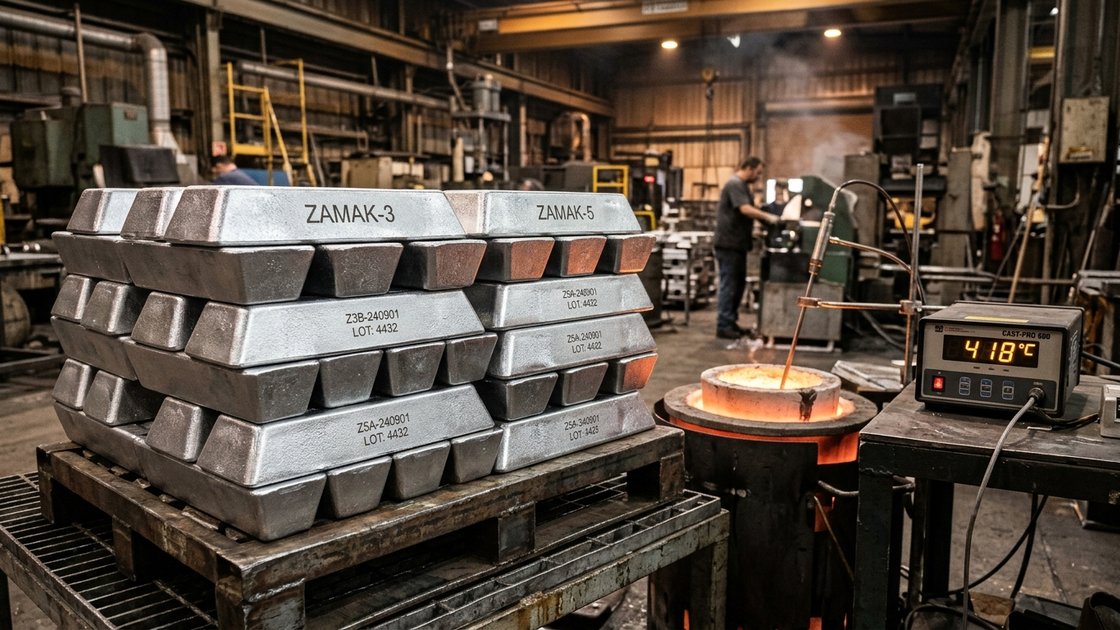
Every production heat at ArtisZinc begins with certified primary SHG (Special High Grade, 99.995% pure) zinc alloyed strictly to ASTM B240 ingot specifications (casting spec ASTM B86 / EN 1774 ZL0400 & ZL0410). For decorative figurines, fridge magnets, and medallions, Zamak-3 is ideal. However, the moment a drawing includes an active bottle-opening jaw, carabiner boss, or load-bearing wrench slot, we evaluate Zamak-5.
What separates Zamak-3 from Zamak-5 is a controlled copper addition between 0.75% and 1.25%, paired with tightly held aluminum (3.9%–4.3%) and magnesium (0.03%–0.06%). Solid-solution strengthening and epsilon-phase precipitation from that 1% copper addition transform the mechanical envelope of a bottle opener jaw:
- Ultimate Tensile Strength (UTS): Rises from 283 MPa (41,000 psi) in Zamak-3 to 328 MPa (47,600 psi) in Zamak-5—a 15.9% gain in fracture resistance across the side arms flanking the cap window.
- 0.2% Offset Yield Strength: Increases from 221 MPa in Zamak-3 to 269 MPa in Zamak-5, preventing upward mushrooming or denting of the pry lip against hardened steel crown skirts.
- Brinell Hardness: Climbs from 82 HB to 91 HB, improving gouge resistance on contact edges over years of pub counter service.
- Shear Strength: Moves from 214 MPa in Zamak-3 up to 262 MPa in Zamak-5—a 22.4% improvement resisting combined pry-and-twist shearing.
| Metallurgical & Mechanical Parameter | ASTM B240 Zamak-3 (UNS Z33521) | ASTM B240 Zamak-5 (UNS Z35530) | Unregulated Shop Scrap Zinc |
|---|---|---|---|
| Aluminum (Al) Content (wt%) | 3.90% – 4.30% | 3.90% – 4.30% | 2.40% – 5.10% (Unstable) |
| Copper (Cu) Content (wt%) | ≤ 0.10% max (Castings ≤ 0.25%) | 0.75% – 1.25% | 0.05% – 2.80% (Contaminated) |
| Magnesium (Mg) Content (wt%) | 0.025% – 0.05% | 0.03% – 0.06% | < 0.01% (Burned off in remelt) |
| Lead (Pb) / Cadmium (Cd) Impurity | Pb < 0.0020% / Cd < 0.0010% | Pb < 0.0020% / Cd < 0.0010% | Pb > 0.035% (Fails Prop 65) |
| Ultimate Tensile Strength (MPa) | 283 MPa | 328 MPa | 145 – 190 MPa |
| Shear Strength at Jaw Lip (MPa) | 214 MPa | 262 MPa | 110 – 140 MPa |
| Brinell Hardness (500 kg, 10 mm) | 82 HB | 91 HB | 60 – 74 HB (Pits & Sludges) |
| Charpy Impact Strength (Unnotched) | 58 J (43 ft·lbf) | 65 J (48 ft·lbf) | 9 – 18 J (Brittle Cleavage) |
When a client orders a thick 6.5 mm souvenir coin opener with a concealed stainless steel insert screwed into the rear recess, Zamak-3 offers superb fluidity for 0.12 mm architectural reliefs. Conversely, for monolithic zinc bar blades, shark-jaw keychain openers, or executive openers where the cast jaw directly bites the steel crown cap, ArtisZinc mandates virgin Zamak-5 as our baseline.
3. Cantilevered Jaw Bending & Shear Equations Used in Our DFM Review
Whenever a designer sends us a STEP or IGES 3D model for a custom opener, my tooling engineers slice two cross-sections in Siemens NX before quoting steel tooling: Section A-A through the root of the lower pry tooth, and Section B-B across the twin side struts framing the cap aperture. We model the lower pry lip as a tapered cantilever beam subjected to combined transverse shear and bending moment, modified by geometric stress concentration factor Kt at the throat fillet.
1. Bending Stress at Tooth Root: σb = Kt · (6 · Flip · Ltooth) / (b · h2)
2. Transverse Jaw Shear Stress: τmax = (1.5 · Flip) / (b · h)
3. Equivalent Von Mises Stress: σvm = √(σb2 + 3 · τmax2) ≤ (σy,Zamak5 / SF), where Safety Factor SF ≥ 2.25
Plug real shop numbers into this formula to see why a 2.0 mm root thickness adjustment determines whether an opener lasts ten years or fails on Friday night. Suppose a minimalist design specifies tooth overhang Ltooth = 3.8 mm, contact width b = 7.5 mm, root thickness h = 2.4 mm, and a sharp 0.25 mm internal corner fillet yielding Kt = 2.15. Under an off-axis bartender pry generating Flip = 950 N:
- σb = 2.15 × (6 × 950 N × 3.8 mm) / (7.5 mm × 2.42 mm2) = 1,078 MPa—nearly four times Zamak-5's yield strength, guaranteeing low-cycle fatigue fracture within forty bottles.
- In ArtisZinc's DFM revision, we thicken the tooth root h from 2.4 mm to 4.4 mm along the underside bevel, widen engagement arc b to 11.0 mm across three crown flutes, trim overhang Ltooth to 2.9 mm, and sweep a 1.5 mm compound fillet dropping Kt to 1.22.
- Recalculating: σb drops to 94.7 MPa and τmax to 29.4 MPa, yielding a combined Von Mises stress σvm of just 107.6 MPa—a static safety factor of 2.50 against Zamak-5's 269 MPa yield limit!
4. Hot-Chamber Gooseneck Thermal Stability & Preserving the Dense 0.4mm Chill Skin
A zinc alloy casting is never uniform across its thickness. When molten Zamak-5 strikes a water-cooled H13 steel cavity hardened to 46–48 HRC, metal touching the cavity wall freezes at cooling rates above 500°C/s. This rapid quench forms an ultra-fine-grained outer "chill skin" 0.35 mm to 0.50 mm thick on both faces, possessing up to 25% higher tensile fatigue strength than the slower-cooling core.
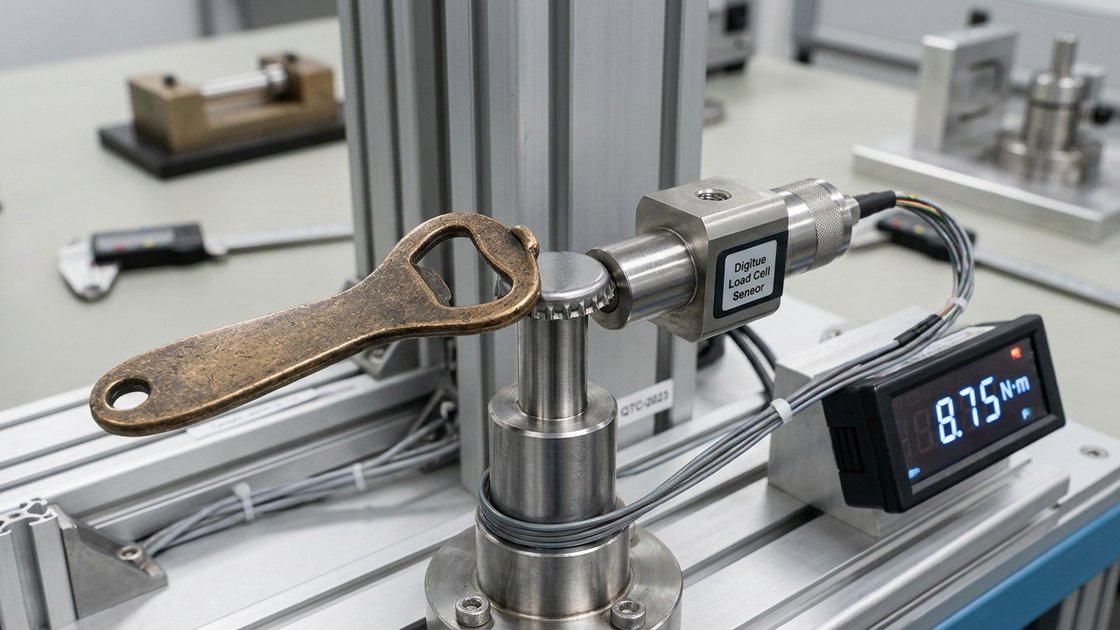
Two shop errors destroy that chill skin. First, allowing furnace temperatures to swing between 405°C and 455°C. At ArtisZinc, our 88-ton and 130-ton computer-controlled hot-chamber cells hold gooseneck pot temperatures strictly between 415°C and 422°C, paired with PID mold thermal oil units maintaining cavity steel at 165°C to 185°C. Above 435°C, magnesium burns out of the bath—destroying intergranular corrosion resistance—while excess heat causes solder build-up on jaw cores. Second, coarse belt grinding across functional jaw edges strips away the dense 0.4 mm skin and exposes subsurface pores prior to plating. Therefore, we feed molten Zamak-5 through a tail perimeter fan gate at 38 to 46 m/s, sweeping air past the jaw into sacrificial overflow wells without ever gating directly onto the working tooth.
5. Vacuum-Assisted Overflow Wells & Real-Time X-Ray Porosity Gatekeeping
Inspect an untrimmed biscuit spray freshly ejected from an ArtisZinc bottle opener mold and you will see kidney-shaped sacrificial tabs attached outboard of the pry jaw via thin 0.45 mm flash bridges. Sized at 15% to 22% of local jaw volume, these overflow wells work alongside synchronized vacuum-assist valves that pull cavity pressure below 85 mbar milliseconds before metal arrival. The turbulent initial metal front—carrying entrained air and release-agent vapor—shoots past the pry tooth into the overflow well, leaving laminar liquid Zamak-5 packed under 32 MPa intensification pressure inside the opener jaw.
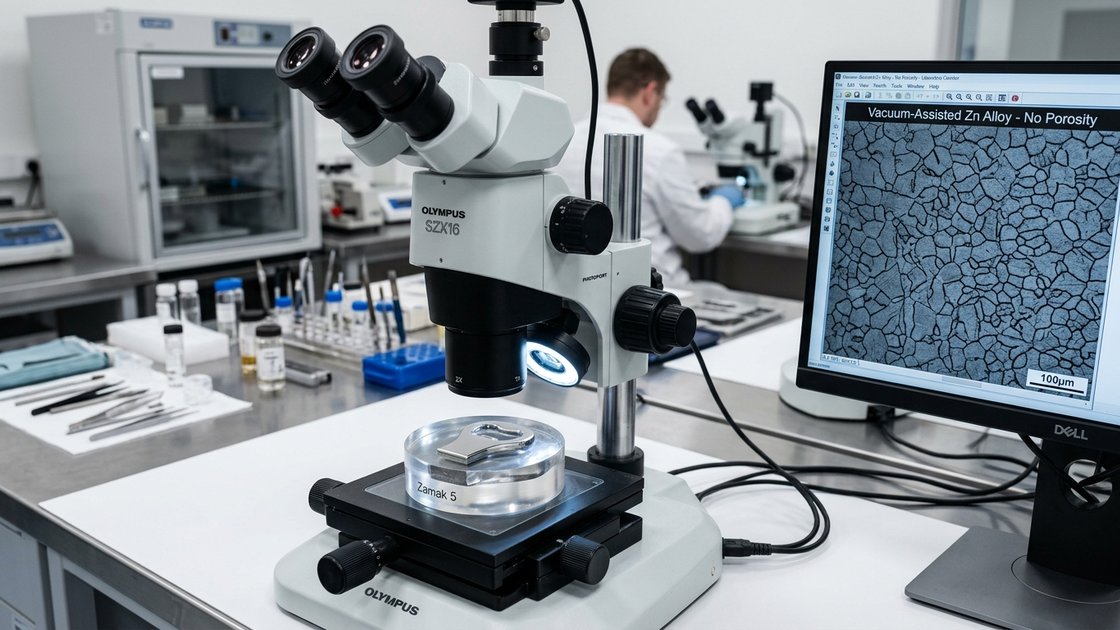
Before locking any new H13 mold's shot profile into our MES controller, we pull twenty consecutive T0 shots for real-time X-ray cabinet scanning, diamond-saw cross-sectioning, and 45 N·m torque testing. Every ArtisZinc heavy opener design must endure 45 N·m static torque without cracking and survive 5,000 automated pneumatic cycles against a 52 HRC steel crown simulator (<0.15 mm lip wear) before T1 golden samples ship.
6. Shop-Floor Production & Quality Control SOP for Custom Bottle Openers
To prevent batch drift across repeat runs from 500 to 100,000 units, every bottle opener SKU follows our seven-gate serialized traveler protocol:
| Process Gate | Control Parameter & Target Window | Inspection Instrument / Standard | Sampling Cadence & Reject Action |
|---|---|---|---|
| Gate 1: Ingot & Melt Quarantine | Al 3.9–4.3%, Cu 0.75–1.25%, Mg 0.03–0.06%; Pb < 20 ppm, Cd < 10 ppm | Spark OES Spectrometer (ASTM B240 / Prop 65) | Every ingot bundle + 1 furnace puck per 4-hour shift; lock pot if out of spec |
| Gate 2: Hot-Chamber Shot Control | Gooseneck 415°C–422°C; Gate speed 38–46 m/s; Clean runner remelt ≤ 20% | PID Thermocouple + Plunger Velocity Encoder | 100% shot-curve monitoring; auto-divert biscuit if plunger velocity drifts > 5% |
| Gate 3: Internal Density & Trim | Zero pores > 0.3 mm in jaw root; trim flash ≤ 0.08 mm preserving chill skin | Digital X-Ray Fluoroscopy (ASTM E505 Level 1) + Trim Die | 20 pcs at T0 setup + 5 pcs per 500 shots; tune vacuum/overflow if voids appear |
| Gate 4: Vibratory Deburr & Buff | Preserve 0.35 mm dense skin on pry tooth; mirror zone Ra ≤ 0.20 μm | Mitutoyo Profilometer + Ultrasonic Degreaser | AQL 1.5 check; prohibit coarse belt grinding across active jaw tooth |
| Gate 5: Multi-Layer Rack Plating | Alkaline Cu 8 μm + Duplex Ni or White Bronze + Finish + 10 μm E-coat | XRF Thickness Gauge + Cross-Hatch ASTM D3359 (5B) | 5 pcs per rack lot; 72h–96h ASTM B117 neutral salt-spray witness coupons |
| Gate 6: Mechanical Jaw Torque & Pry | Static torque ≥ 45 N·m zero fracture; 200 live steel crown openings post-plate | Digital Torque Rig + DIN EN 17177 Crown Cap Fixture | 10 pcs destructive/functional audit per 2,500-pc batch; zero cracking or flaking |
| Gate 7: Final XRF & Packaging | Pb < 20 ppm, Cd < 10 ppm, Ni release compliant; drop-tested export carton | Benchtop XRF + ISTA 1A Carton Drop | AQL 1.0/2.5 pre-shipment inspection with signed CoA in shipping pouch |
7. Stamped SUS420J2 Stainless Jaw Inserts vs. Monolithic Zamak-5
Beverage buyers often ask whether to add $0.14–$0.22 per unit for a dual-screw stamped stainless insert recessed into the back of a zinc body, or cast a monolithic Zamak-5 jaw:
- Monolithic Virgin Zamak-5 excels on bar blades, sculpted 3D shark/dragon jaws, and heavy contours with ≥4.0 mm jaw root thickness—eliminating screw-loosening risks while passing 45 N·m torque and 15,000+ pry cycles.
- Recessed Hardened SUS420J2 (48 HRC) Inserts suit ultra-thin (≤3.0 mm) credit-card openers or delicate filigree magnet-openers where narrow struts drop below 3.2 mm. We cast twin anti-rotation bosses alongside Loctite-bonded M2.5 stainless screws so the steel insert never twists loose.
8. Ergonomic Palm Pressure Distribution, Wall-Mount Bosses & Brewery Branding Durability
Mechanical survival at the jaw throat is half the battle; the other half is making sure a bartender in Munich, Chicago, or Melbourne actually reaches for your branded opener ahead of generic stamped steel flat-bars during a Friday night rush. When someone pops three hundred craft lager bottles over a six-hour shift, sharp 90-degree perimeter flash edges along a poorly finished cast handle dig painfully into the palmar digital crease, raising blisters within an hour.
On every custom bar-blade and sculpted 3D handle engineered at ArtisZinc, we sweep a minimum 1.8 mm to 2.5 mm ergonomic perimeter bullnose radius around the grip tail and balance longitudinal mass distribution so the center of mass sits 12 mm to 18 mm aft of the jaw throat—giving the opener an effortless, authoritative forward snap into the palm. For cast wall-mounted pub and patio bottle openers ("Open Here" heritage plaques), the load vector flips: downward handle leverage pulls the upper mounting screw boss in pure tension away from the wooden post or brick wall. We reinforce upper countersunk #8 screw bosses with four radial gusset ribs on the hollow backside (ribbing thickness = 0.65× nominal wall thickness so zero sink marks telegraph onto the front emblem!), sustaining 1,400 N of pull-out leverage without cracking the mounting ear.
For brewery crest customization on high-wear grip faces, we steer beverage clients away from un-recessed surface pad printing, which rubs off under wet bar towels and sanitizer solutions (quaternary ammonium chlorides and ethanol). Instead, we sink logos 0.80 mm below raised protective metal borders filled with kiln-baked chemical-resistant epoxy enamel, or deep-engrave emblems via 50-watt fiber laser straight into brushed satin pewter or antique brass prior to 155°C E-coat sealing—surviving commercial three-compartment bar-sink sanitizing indefinitely.
Engineering Floor Q&A: Sourcing Heavy Custom Bottle Openers
Q1: Can recycled zinc sprue runners be blended at all without risking the 40th-cap jaw snap?
Marcus Lin: Under ASTM B86 foundry controls, re-melting up to 20% clean, unplated, in-house Zamak-5 runners via fluxed remelt pigs—verified by spark OES on every shift—causes zero loss in tensile or impact strength. Failures come from external scrap ingots contaminated with plated copper/nickel skins, iron hardware, and high-lead solder.
Q2: Does electroplating cause hydrogen embrittlement or oven blistering on Zamak-5 openers?
Marcus Lin: Zinc alloys do not suffer martensitic steel lattice embrittlement, but aggressive acid pickling traps hydrogen in subsurface micropores that expands into blisters inside 150°C E-coat curing ovens. We prevent blistering via mild 10-second fluoride-balanced activation and cyanide-free alkaline copper strike baths.
Q3: How do you stop antique brass or matte black plating from scraping off the pry tooth immediately?
Marcus Lin: Crown skirts generate over 600 MPa Hertzian contact stress. We deposit an 8 μm ductile copper base plus 10 μm semi-bright nickel or white-bronze barrier, apply the decorative patina, and seal the opener with a 10–12 μm cathodic polyurethane electrophoretic clearcoat baked at 155°C (≥3H pencil hardness) so wear polishes smoothly without flaking.
Q4: Will Zamak-5 bottle openers turn brittle when used outdoors at -15°C winter tailgates or ski resorts?
Marcus Lin: All hexagonal close-packed (HCP) zinc alloys experience a ductile-to-brittle transition in unnotched Charpy impact toughness below 0°C, dropping from 65 J at +20°C down to roughly 8–12 J at -20°C—though static tensile strength actually increases slightly in the cold! Because our virgin Zamak-5 openers eliminate sharp internal notches (Kt ≤ 1.22 via generous 1.5 mm throat fillets) and keep lead/tin impurities strictly below 20 ppm, our ski-resort and winter-festival openers pass -20°C cold-soak drop testing onto concrete from 1.2 meters without fracture.
Q5: What are your tooling lead times, MOQs, and mold fee refund terms for custom bottle openers?
Marcus Lin: Send a 2D vector or 3D STEP file to [email protected] for a 24-hour jaw-stress DFM review and 48-hour metal-weighted prototype. H13 steel molds cut in 7 to 9 days, mass production ships in 12 to 16 days, and MOQs start at 200 pcs (stocked frames) or 500 pcs (custom molds) with a 100% mold fee refund at 5,000 cumulative units. Every export shipment includes serialized optical emission melt records, coating thickness logs, and destructive torque certificates so hospitality procurement teams enjoy complete metallurgical traceability from foundry ingot to retail taproom delivery.
Need a Free 12-Hour Mold-Flow & Plating Review on Your Design?
Send your 2D vector art or 3D STEP/STL sculpture directly to Marcus Lin's tooling desk for wall-thickness, draft-angle, and cost-tier optimization.
More Peer-Reviewed Metallurgical & Tooling Whitepapers
- → Hard Enamel Cloisonné vs. Recessed Soft Enamel Keychains: Lapping Tolerances, 0.15mm Metal Dam DFM & Split-Ring Fatigue (Keychain Craft & Enameling • 14 min read)
- → Engineering Zero-Drop 3D Souvenir Fridge Magnets: Recessed N52 Neodymium Bonding, Coastal Salt-Fog Defense & Multi-Layer Riveting (Souvenir Fridge Magnets • 14 min read)
- → Sculpting 28mm–75mm Die-Cast Zinc Alloy Figurines: Four-Slide Core Pulls, Invisible Parting Lines & Centrifugal vs. Steel Tooling (Metal Figurines & Miniatures • 14 min read)
- → Manufacturing Heirloom Enameled Zinc Alloy Trinket Boxes: ±0.03mm Hinge Coaxiality, Magnetic Closure Damping & Hand-Set Crystal QC (Hinged Jewelry & Trinket Boxes • 14 min read)
- → Passing ASTM B117 96-Hour Salt Spray & California Prop 65 on Custom Zinc Alloy Gifts: Duplex Plating, Nickel-Free Finishes & XRF Gatekeeping (Surface Finishing & Compliance • 14 min read)